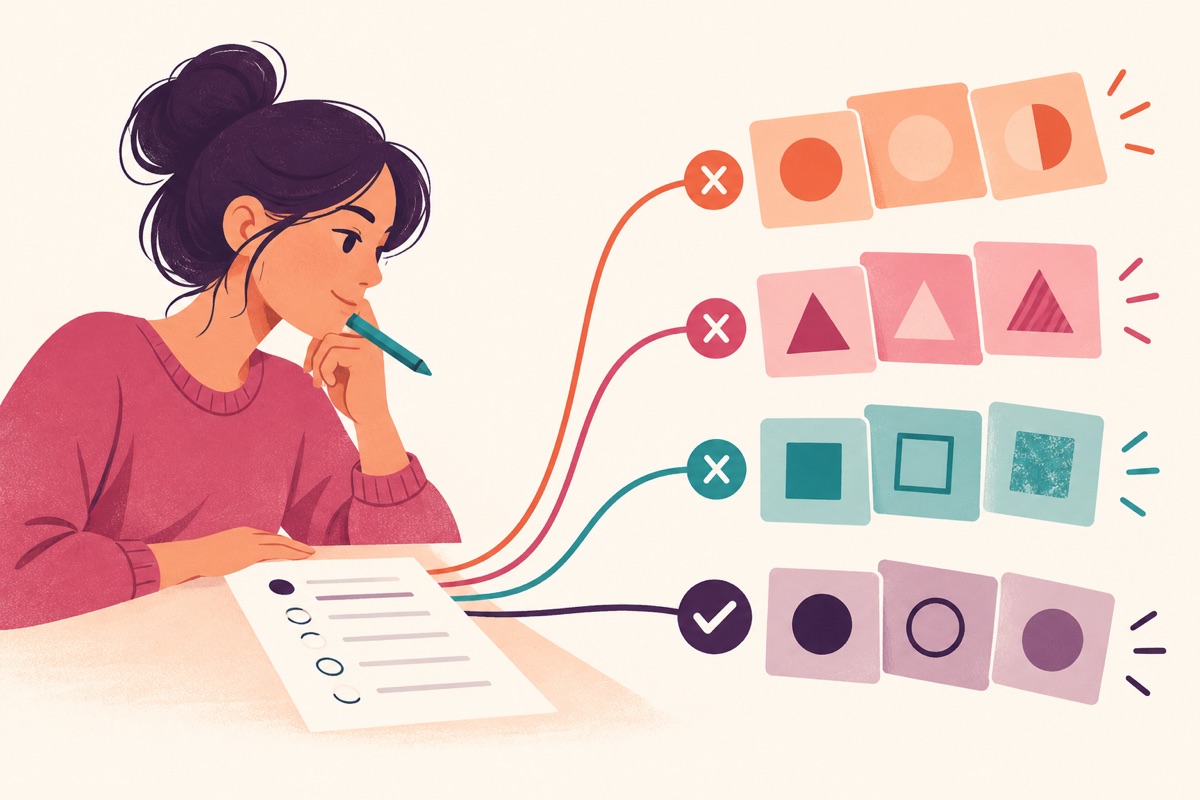
PROVE the Answer or Don't Pick It

Here is a moment I watch play out every single week. You're on a GRE Verbal question. You've knocked it down to two choices. Both sound smart. You stare. You reread the passage. You stare some more. Then you click the one that 'feels right' and move on with a little knot in your stomach.
Let me be blunt: that wasn't an answer. That was a GUESS wearing a nice suit.
Don't get too down on yourself, because this is fixable. The fix is easy to say and hard to do. On GRE Verbal, every correct answer is PROVEN by specific words on your screen. If you can't put your finger on those words, you don't get to pick that choice. No proof, no click.
'Sounds good' is not a reason
The Verbal section asks you to read passages and answer questions about them (that's Reading Comprehension), and to fill blanks in sentences (Text Completion and Sentence Equivalence). The official Verbal page from ETS lays out each type.
Here's what they all share. ETS can't publish a question whose right answer is a vibe. Every question needs an answer that holds up when thousands of smart people argue with it. So the right answer is ALWAYS tied to words in the text. The wrong answers are built to sound good while being tied to nothing, or tied to the wrong thing.
So 'it sounds good' tells you nothing. EVERY choice on the GRE sounds good. That's the job of the people who write them.
Why proof makes you FASTER
Some people hear 'find the proof' and think 'that sounds slow.' Look at the clock. Verbal comes in two sections: 12 questions in 18 minutes, then 15 questions in 23 minutes. That's roughly a minute and a half per question on average. Not a ton of time.
Now stop reading and think about your last slow Verbal question. Where did the time actually go? I'll bet it wasn't the first read. I'll bet it was the back and forth between two choices, rereading, second guessing, switching, switching back.
Proof kills that loop. 'Which one do I like more?' has no end. 'Which one can I point to?' has a yes or no answer. A choice with no proof is gone in seconds. You stop arguing with yourself and start checking, and checking is quick.
5 ways people skip the proof
Picking the choice that matches the main idea, no matter what was asked. You saw it above. The main idea is everywhere in the choices because it's tempting.
INSTEAD: Reread the QUESTION, not the passage. Write down what it's about in two or three words. The proof has to answer THAT.
Using what you already know about the topic. Say you're a history buff and you KNOW medieval records were messy. Great. The GRE doesn't care.
INSTEAD: Only the words on the screen count. If your proof comes from your own head, it's not proof.
Letting one big word slide. Words like 'every,' 'always,' 'never' and 'only' make a choice harder to prove. Wrong choices follow patterns you can learn, and the too strong claim is one of the most common.
INSTEAD: Your proof has to be as strong as the choice. A passage that says 'some' can't prove a choice that says 'all.'
'Proving' it in your head. You tell yourself you found the line. Did you? Or did you find a line that's sort of nearby? Doing this mentally is pride, and pride costs points.
INSTEAD: Jot two or three words of the proof in your notes, or at least name which sentence it's in. If you can't write it, you didn't find it.
Rereading the whole passage to hunt for help. That's the slowest move on the test, and it's what people do when they don't know where anything is.
INSTEAD: Paraphrase every sentence as you read so you have a map. Then go to ONE spot, not the whole thing.
If this feels like the skill of picking apart a weak argument, you're right. The Argument essay is gone, but its skills are not, and this is one of the places they pay off.
Proof works on blanks too
People think proof is just for passages. Nope. In a fill in the blank question, the proof is the clue in the sentence that tells you what the blank must mean. Find it BEFORE you look at the choices. Signal words like 'although' and 'because' are often half the proof.
The real question
So you have to decide what you want MORE: the comfort of going with your gut, or a Verbal score you actually earned. Gut feel works fine on easy questions. It breaks on exactly the questions you need to get right to move up.
Here's your job for today. Pull 10 Verbal questions you've ALREADY done. For each one, write down the exact words that prove the right answer, and one reason with proof that kills each wrong choice. Any question where you can't do it is a question you got right by luck, or wrong for a reason you can now see. Then do a short timed set with one rule: you're not allowed to click until you've written your proof. Time it. I'll bet you're not slower. I'll bet you're FASTER.