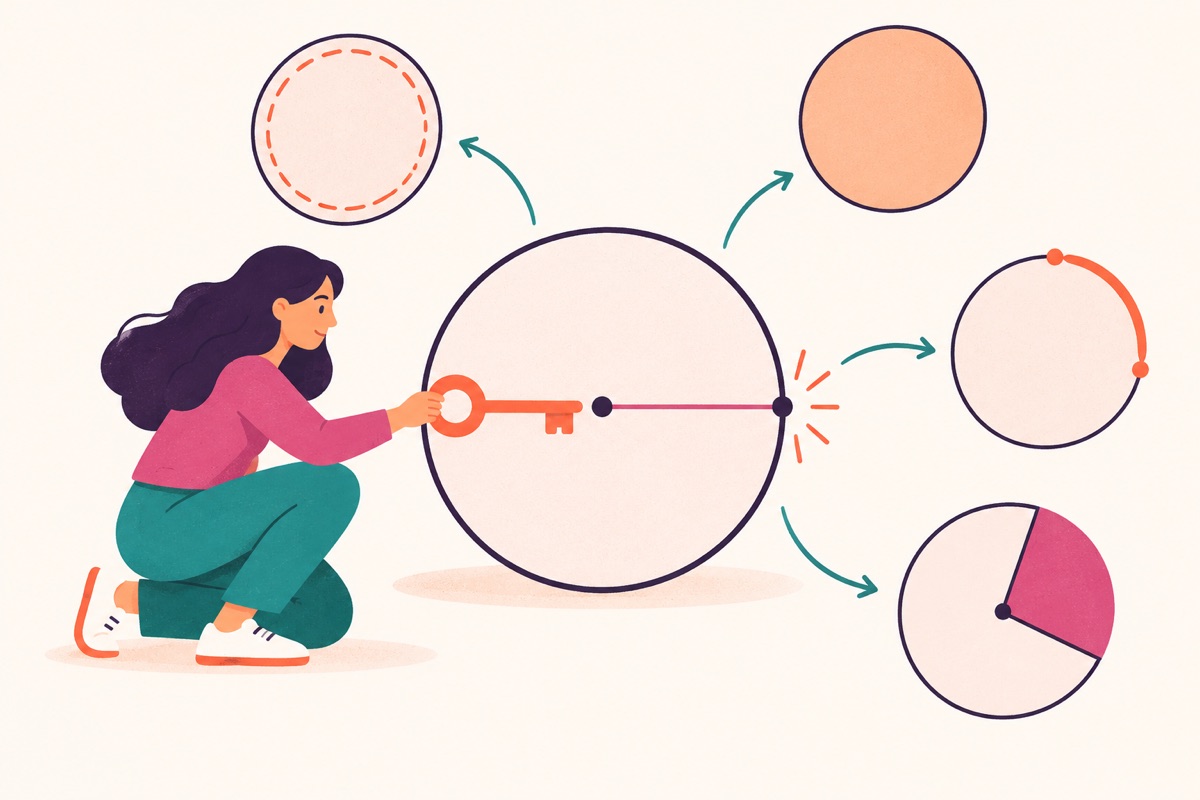
Volume and Surface Area: Stop Memorizing Formulas You Can BUILD
Second Quant section. Question 9 of 15. A cylinder shows up, and your brain goes blank. You KNOW you memorized that formula. Was it 2πr² plus something? πr²h? Something with a 4/3 in it? You stare. Thirty seconds pass. Then a minute. Now you are behind the clock, rattled, and guessing on a question you could have solved by peeling the label off a soup can.
I watch people do this every week. They treat geometry like a vocabulary list: memorize eight formulas, hope they all survive Test Day. Here is my verdict: memorizing volume and surface area formulas is a FRAGILE plan. Building them is a strong one. And building takes seconds once you own two simple ideas.
The forced choice
What do you want MORE: a list of eight formulas you half remember, or TWO ideas you cannot forget? Because those two ideas will rebuild every formula on that list, plus the weird shapes no list covers.
First, two quick terms. Volume is how much stuff fits inside a solid, like how much water fills a can. Surface area is how much material covers the outside, like how much paper you need to wrap it.
Idea #1: Volume is a stack
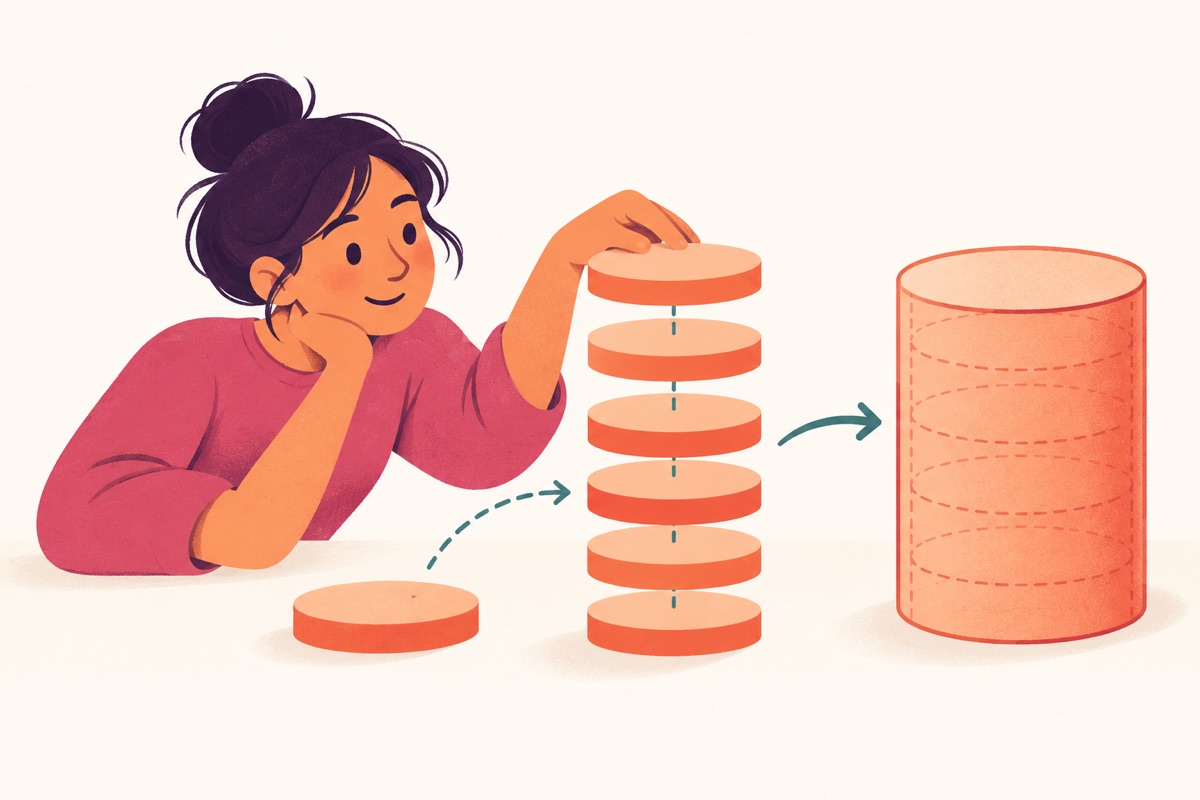
Take one coin. It has a flat circle on top. Now stack 50 identical coins. You built a cylinder. The space it takes up is just the area of one coin's face, repeated all the way up.
So for any solid that has the same shape from bottom to top (a box, a cylinder, a triangle-shaped tube called a prism), the rule is:
Volume = area of the base × height
Now watch every formula fall out of that one line:
- Box: the base is a rectangle, length × width. Stack it up: length × width × height.
- Cube: the base is s × s. Stack it s high: s × s × s = s³.
- Cylinder: the base is a circle, area πr² (r is the radius, the distance from the center to the edge). Stack it h high: πr²h.
- Triangular prism: the base is a triangle, ½ × base × height of the triangle. Stack it along the length.
Stop reading for a second. Cover the list above and rebuild the cylinder formula from the coin picture. I'll bet it took you less time than it took to read this paragraph. THAT is the point.
Idea #2: Surface area is unwrapping
Surface area has no magic. Unfold the solid until it lies flat, find the area of each piece, and add them up.
A box has 6 faces that come in 3 matching pairs: top and bottom, front and back, left and right. Find each pair, double it, add.
A cylinder is where people panic, so let's unwrap one. You get two circles (the top and the bottom) and one rectangle (the label). The label's height is the can's height, h. Its width is the distance around the circle, called the circumference, which is 2πr. So the label's area is 2πr × h.
Add the pieces: two circles at πr² each, plus the label at 2πrh. Total: 2πr² + 2πrh. You did not memorize that. You BUILT it. If the circle pieces feel shaky, go back to why the radius unlocks everything in circles, because every number here comes from r.
Why building beats memorizing on THIS test
The GRE Quant sections are tight. The first gives you 12 questions in 21 minutes and the second gives you 15 in 26 minutes, per the ETS Quant section page and the current test format. Do the math on your paper: 21 ÷ 12 is 1.75 minutes, so about 1 minute 45 seconds per question on average. A one-minute freeze on a formula eats more than half of that.
But speed is not even the biggest reason. The test loves shapes that are NOT the textbook shape. A can with no lid. A box with an open top. A pool. A memorized formula answers the textbook shape and gets the twist wrong. A built formula fits whatever is in front of you.
The mistakes I see over and over
- Cramming a formula sheet the night before. You walk in with eight formulas balanced on top of your stress, and one wobble knocks them all down.
INSTEAD: learn the stack idea and the unwrap idea. Build each formula from scratch on paper until you can do it without thinking. - Using the "full" formula on a shape that isn't full. Open boxes, lidless cans and pools with no top all break the standard formula.
INSTEAD: sketch the shape and write a list of its faces before you calculate anything. Ten seconds of notes beats a wrong answer. - Mixing up radius and diameter. The question gives you a diameter (the full width across the circle), and you plug it in as r.
INSTEAD: always write "r = ___" as your first note on any circle or cylinder question. Never let a number go into a formula until it has a label. - Doing the π arithmetic in your head. Turning π into 3.14 early creates ugly decimals and silly mistakes, and the answer choices are usually in terms of π anyway.
INSTEAD: keep π as a label until the very end. In comparisons, it often cancels out and you never touch it.
One more thing building gives you
Once you think of volume as a stack, scaling questions get easy. Double a cylinder's radius and the base circle gets 2 × 2 = 4 times bigger, so the volume is 4 times bigger. Double the height instead and you just stack twice as many coins, so the volume doubles. No formula needed. You can SEE it. That same habit of looking for the structure underneath, instead of memorizing rules, is what makes absolute value as distance and finding the cycle in sequences click too. The GRE is a predictable test. Train the idea, and the questions stop surprising you.
Your challenge for today
Grab a blank sheet of paper. No notes, no phone. Build the volume AND the surface area for a box, a cube, a cylinder and a closed triangular prism, using only the stack idea and the unwrap idea. Time yourself. Then do it again for an open-top box. If any shape takes you more than a minute, that is the one you drill tomorrow. When you can rebuild all of them without a stall, go test yourself on real timed questions from ETS's free POWERPREP practice tests, and watch what happens the next time a cylinder shows up on question 9.