Circles: The Radius Unlocks EVERYTHING
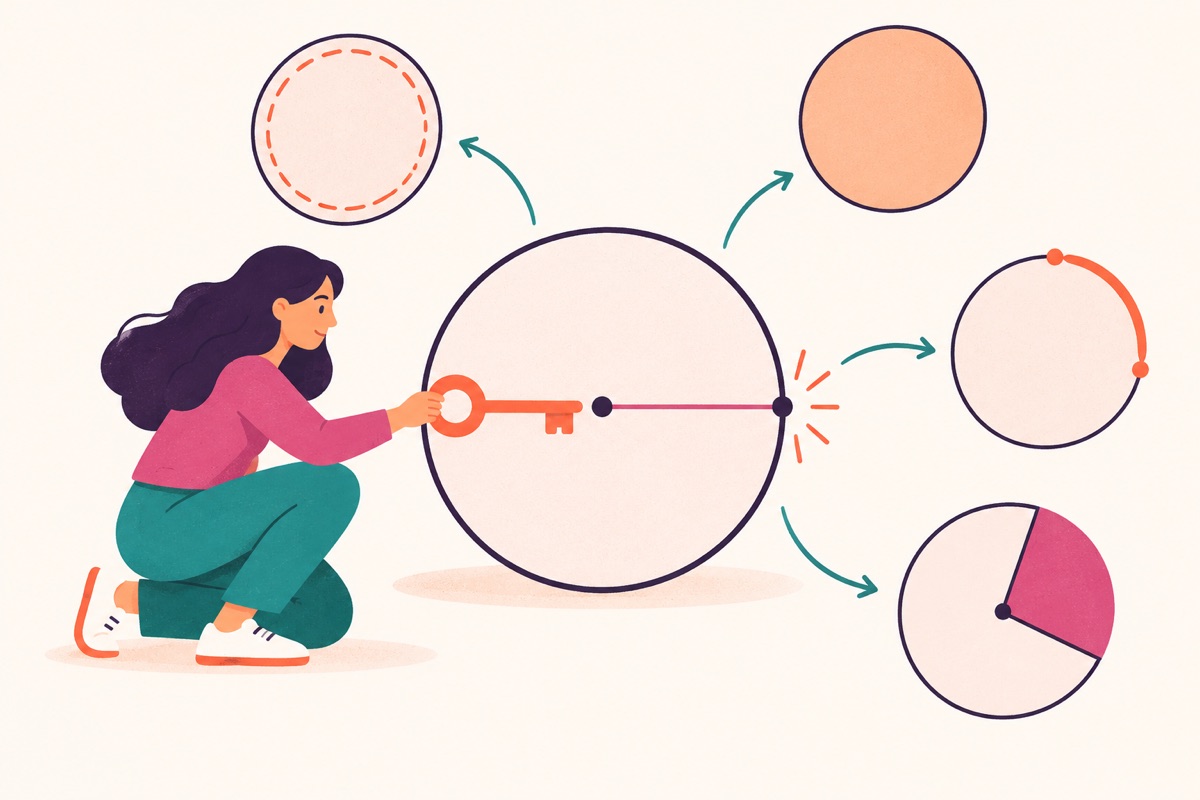
Here is a scene I watch play out all the time. A GRE circle question pops up. It gives you the circumference and asks for the area of a slice. The test taker stares at the screen, mutters a formula, starts multiplying things by 3.14, gets an ugly decimal, and then panics because none of the answer choices look like that decimal. Two minutes gone. Wrong answer picked out of frustration.
Here is my blunt verdict: almost every GRE circle question is a radius question wearing a costume. The radius is the distance from the center of a circle to its edge. Find it FIRST, write it down, and the rest of the question usually falls over on its own.
One number runs the whole circle
Stop and think about this for a second. How many different facts can you know about a circle? Diameter, circumference, area, arcs, slices. It feels like a lot. It is really one fact, because every one of those is built from the radius.
- The diameter is the distance straight across the circle through the center. It is 2 radii.
- The circumference is the distance around the circle, like the crust of a pizza. It is 2πr.
- The area is all the space inside. It is πr².
The GRE loves to hand you one of these and ask about another. So you need to go both ways: from the radius out, and from anything back to the radius.
| If they give you | Get the radius like this |
|---|---|
| Diameter d | r = d ÷ 2 |
| Circumference C | Set 2πr = C, then divide by 2π |
| Area A | Set πr² = A, divide by π, then take the square root |
Notice what is NOT on that table: a calculator, a decimal or the number 3.14. The π usually cancels out. If you turn π into a decimal too early, you make the math harder AND you make your answer stop matching the choices, which are often written with π in them.
Arcs and sectors are just slices of pizza
Two more terms. An arc is a piece of the circle's edge, a piece of crust. A sector is a full slice, crust and cheese together. The central angle is the angle at the center of the circle where the slice comes to a point.
A full circle is 360 degrees. So a slice with a central angle of 90 degrees is 90 out of 360, which is 1/4 of the circle. That fraction does ALL the work:
- Arc length = (angle ÷ 360) × circumference
- Sector area = (angle ÷ 360) × area
That's it. No new formula to memorize. Find the radius, build the whole circle, then take your fraction of it. If you've read our post on weighted averages, you have seen this same idea before: figure out what fraction of the whole you are dealing with and let the fraction carry the math.
Circles hiding inside other shapes
The harder GRE questions don't leave the circle alone. They stick a square inside it, or a triangle, and they hope you'll forget the radius is still in charge. Two facts carry most of these:
- Any line from the center to the edge is a radius. So if two lines both start at the center and hit the edge, they are the SAME length. Draw them in. Suddenly you have a triangle with two equal sides.
- Any line across the circle through the center is a diameter. If a square sits inside a circle with its corners touching the edge (we call that inscribed), the square's diagonal goes through the center. So the diagonal IS the diameter.
One quick format note before you try the next one. Quantitative Comparison questions give you two quantities, A and B, and ask which is bigger. You don't need an exact answer. You just need to know which side wins.
The mistakes that cost you circle points
I'll bet that when you look back at the circle questions you've missed, you'll find the math was never the hard part. The misses come from the same few habits.
- Grabbing the first number and calling it the radius. The question says diameter 10 and your hand writes r = 10. INSTEAD: Before you do anything else, write "r = ?" on your paper and fill it in on purpose. Every circle question, every time.
- Turning π into 3.14 right away. You create decimals the answer choices don't use, and then you have to convert back. INSTEAD: Keep π as π until the very end. Only estimate it when you need to compare, like in a Quantitative Comparison.
- Memorizing separate formulas for arcs and sectors. More formulas means more chances to grab the wrong one under pressure. INSTEAD: Remember one idea: slice = (angle ÷ 360) × whole. Build the whole circle first.
- Doing it all in your head. Circle questions have three or four small steps. Skip writing one down and you will mix up area and circumference. INSTEAD: Notes on paper. Given, want, radius, whole, fraction, slice. Same order every time.
- Not drawing the radii in. The question shows a square in a circle and you just stare at it. INSTEAD: Draw every line from the center you can. Each one is a free piece of information.
- Trusting the picture over the numbers. A slice that LOOKS like a quarter isn't a quarter unless the angle says 90. INSTEAD: Treat the drawing as a sketch. Let the numbers decide.
Why this matters for your clock
On the current GRE, your first Quant section gives you 12 questions in 21 minutes, and the second gives you 15 questions in 26 minutes. That's roughly a minute and three quarters per question on average, per ETS's Quant section page and the current test layout. A circle question that you handle with a fixed routine can take well under a minute. One that you wander through can eat three. Pacing trouble isn't a clock problem. It's a method problem, and the radius routine is a method. The same idea shows up in our post on remainders: find the one thing the question is really about, and everything else gets easy.
Your challenge for today
Pull 5 circle questions from your practice material or from ETS's free POWERPREP practice tests. Before you read the answer choices, write "r = " on your paper and fill it in. Then build the whole circle, then the slice. Time each one. When you're done, look at the ones you got wrong and answer one question honestly: did you find the radius FIRST? I'll bet you didn't. Fix that one habit today and watch what happens.