Absolute Value: Think DISTANCE, Not Rules

Say you're in the second Quant section. Fifteen questions, 26 minutes, and the timer in the corner is NOT your friend. You hit |x − 3| < 5 and your brain reaches for the rule you memorized. Was it "split into two cases"? Does the sign flip on the negative side? Which one gets the "and" and which one gets the "or"? You stall. You guess. Thirty seconds later you're on the next question with a knot in your stomach and a coin flip on your score.
I watch this happen every week. Here's my verdict: the rules aren't wrong. RELYING on them is. Rules you memorized while calm at your kitchen table crack under pressure. A picture doesn't.
Absolute value is a DISTANCE
The absolute value of a number, written with two straight bars like |−7|, is how far that number sits from zero on the number line. That's it. |7| is 7 because 7 is seven steps from zero. |−7| is also 7, because −7 is seven steps from zero in the other direction. Distance is never negative. You can't walk negative 3 blocks to the store.
Now the move that unlocks most GRE absolute value questions: |x − a| is the distance between x and a. So |x − 3| means "how far x is from 3." Not a rule. A distance.
Stop reading for a second. What does |x + 2| mean? Don't read another word until you have an answer.
Got one? Rewrite x + 2 as x − (−2). So |x + 2| is the distance between x and NEGATIVE 2. This is where most people slip, and it might be the most important line in this post.
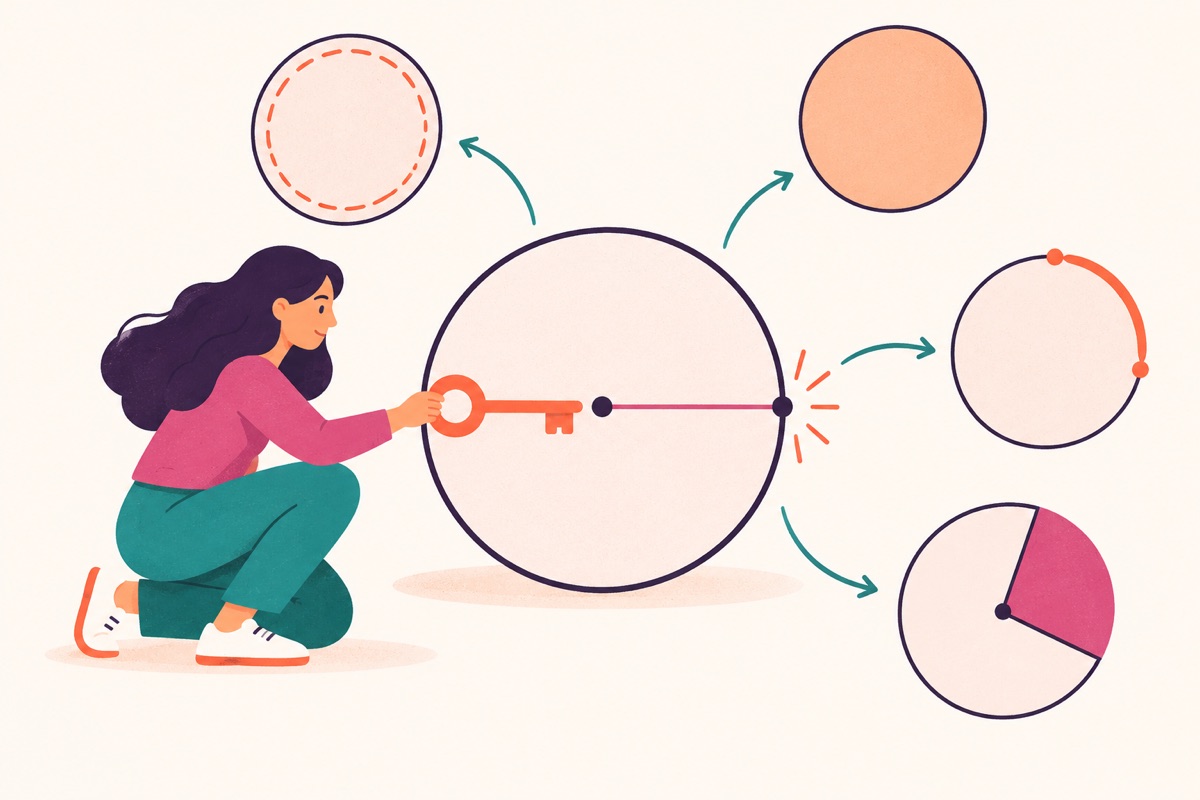
If you've read our take on how the radius unlocks everything in circle questions, this should feel familiar. A circle is every point exactly one distance from a center. Absolute value is the same idea on a line.
Three sentences that replace every rule
- |x − a| = d means x is EXACTLY d away from a. Two spots: a + d and a − d.
- |x − a| < d means x is LESS than d away from a. Everything between those two spots.
- |x − a| > d means x is MORE than d away from a. Everything outside those two spots, running off in both directions.
Draw the center. Step out d both ways. Shade in or shade out. That takes about five seconds on your scratch paper, and it works the same way at minute 2 as it does at minute 24.
The GRE Quant section uses a few different question formats, and absolute value shows up in all of them. Let's run the picture through three.
The mistakes I see every week
Dropping the bars and solving one case. It's fast, and it's wrong about half the time, which is the worst kind of fast.
INSTEAD: Every time you see absolute value, draw the center and step out BOTH ways. Two spots, every time, then decide in or out.
Misreading the center when there's a plus sign. |x + 5| is NOT about 5. It's about −5.
INSTEAD: Rewrite the plus as "minus a negative" on your paper before you draw anything. It costs two seconds and saves the question.
Counting the endpoints on a strict inequality. "Less than 5" does not include 5.
INSTEAD: Put an open circle on the ends for < or >, and a filled circle for ≤ or ≥. Then test the endpoint choice against the original. Don't trust your memory, trust the check.
Doing it all in your head. I'll bet the absolute value questions you've missed are ones where you wrote NOTHING down. Go look at your scratch work. I'll wait.
INSTEAD: A number line is three marks and a shaded bar. If you think you're too smart to draw it, that's your pride talking, and pride doesn't earn points.
Why the picture beats the rule
A memorized rule is a fact you have to RECALL. A picture is a tool you USE. Under pressure, recall is the first thing to go. You blank on which way the sign flips. But you will never blank on "step out the same amount both ways," because you can see it.
It's the same reason we push people to make remainders simple by listing out small numbers instead of reciting theorems. The GRE is a predictable test. It rewards the person with a reliable process, not the person with the longest list of formulas.
So decide what you want MORE: to keep your rules because they feel smart, or to get these questions right deep in the second Quant section when the clock is loud and your brain is tired. You can't fully have both.
Your move today
Pull five absolute value questions from whatever practice material you're using. Before you touch any algebra, draw the number line for each one: center, step out, shade in or out. Then test the answer choices against your picture. Time yourself, and compare it to how long these took you last week. Then redo the ones you missed until the picture is automatic. Do it TODAY, not after you "review the rules one more time."