Weighted Averages: The Shortcut Hiding in Mixture Problems

Say you're watching someone work a GRE mixture problem. They read it once. They write x + y = 30. Then 0.10x + 0.40y = 0.20(30). Then they solve for y, plug it back in, multiply some decimals, and somewhere around line five they drop a zero. Two and a half minutes later they click an answer, and it's wrong. I watch some version of this every single week.
Here's the blunt verdict: most mixture problems on the GRE are NOT algebra problems. They are weighted average problems in a lab coat. Once you see that, a lot of them take seconds instead of minutes.
I'll bet the last mixture problem you solved took you longer than it should have. Go look at your notes. I'll wait.
What a weighted average actually is
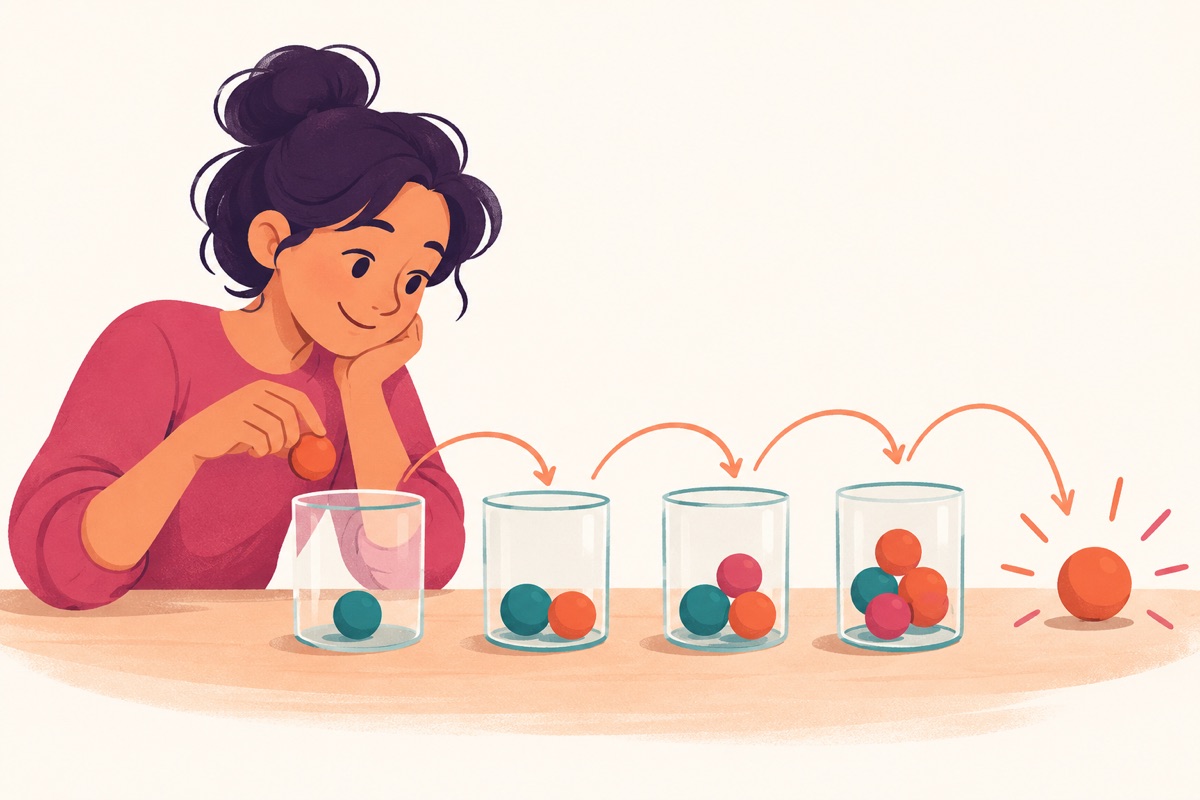
A regular average treats every item the same. A weighted average counts some items more than others, because you have MORE of them.
Say you pour 1 glass of water at 20 degrees into a pitcher, then add 3 glasses at 60 degrees. Is the pitcher 40 degrees? No. Three of the four glasses are hot, so the mix lands closer to 60. The math: (20 + 60 + 60 + 60) ÷ 4 = 200 ÷ 4 = 50 degrees.
That gives you the only two rules you need:
- The mix always lands BETWEEN the two things you mixed.
- It lands closer to whichever one you have MORE of.
Stop reading and answer this: if you mix EQUAL amounts, where does the mix land? Right in the middle. Hold onto that. It's how you'll catch your own mistakes.
The distance trick
Now flip it around. Mixture problems usually tell you the two ingredients and the mix, then ask how much of each you used. Here's the move:
- Put the three numbers on a number line on your paper: low ingredient, mix, high ingredient.
- Find the distance from each ingredient to the mix.
- FLIP those distances. That's the ratio of the amounts.
Check it on the water. 20 is 30 away from 50. 60 is 10 away from 50. Flip them: the 20 degree water gets 10 parts and the 60 degree water gets 30 parts. That's 1 to 3. One glass and three glasses. It works.
Why flip? Because the ingredient you have more of pulls the mix toward itself, so it ends up CLOSER. Small distance means big amount. It's a seesaw: the heavy kid sits near the middle.
Now try it on a real one.
It gets even better on Quantitative Comparison
A Quantitative Comparison question gives you two quantities, A and B, and you pick one of four fixed answers: A is greater, B is greater, they're equal, or you can't tell. ETS lays out the question types on its Quant section page. These questions often don't want an exact number at all. They want a DIRECTION. And weighted averages give you direction for free.
Where this shows up
Anything with two groups and one combined average is a weighted average. Salt in water. Prices of mixed nuts. Two classes with different test averages combined into one. Interest from two accounts. Once you start looking, you'll see them everywhere.
One warning: average SPEED is weighted by time, not by distance. If you drive the same distance at 30 and at 60, you spend more time at 30, so your average lands closer to 30, not right at 45. Always ask, "What am I actually counting the most of?"
Why the seconds matter
The Quant sections give you 12 questions in 21 minutes, then 15 questions in 26 minutes. That's about 1 minute 45 seconds per question on average. As we covered when we looked at how the shorter GRE didn't change your pace per question, the clock isn't your problem. Your METHOD is. A mixture problem you solve in 30 seconds buys you over a minute for the one that really needs it.
This is the same deal as quadratics and factoring: the test repeats its patterns, so you train the pattern until you spot it on the first read.
The mistakes I see every week
- Grabbing two variables by reflex. You see "mixture" and start writing x and y. INSTEAD: draw the number line first. Use algebra only if the number line can't do the job.
- Flipping the ratio the wrong way. This is the single most common miss, and the test puts that wrong answer right there waiting for you. INSTEAD: before you click, ask "Is the mix closer to the ingredient I said there's MORE of?" If not, you flipped it backward.
- Doing the distances in your head. They're small numbers, so it feels safe. It isn't. INSTEAD: write the three numbers and both distances on paper. Every time. Pride is not a strategy.
- Picking "cannot be determined" when a total is missing. INSTEAD: ask whether the RATIO alone answers the question. On mixture comparisons, it usually does.
- Skipping the check. INSTEAD: test your answer by plugging the amounts back in. It takes 15 seconds and turns a guess into a sure thing.
Your move today
Find five mixture or average problems you've already solved with algebra. Redo each one on a number line with the distance trick. Time both versions and write the times next to each other on your paper. Then decide which method you're bringing to Test Day. If you want fresh ones, the free POWERPREP practice tests from ETS are a good place to hunt for them. Do it tonight, not "someday."