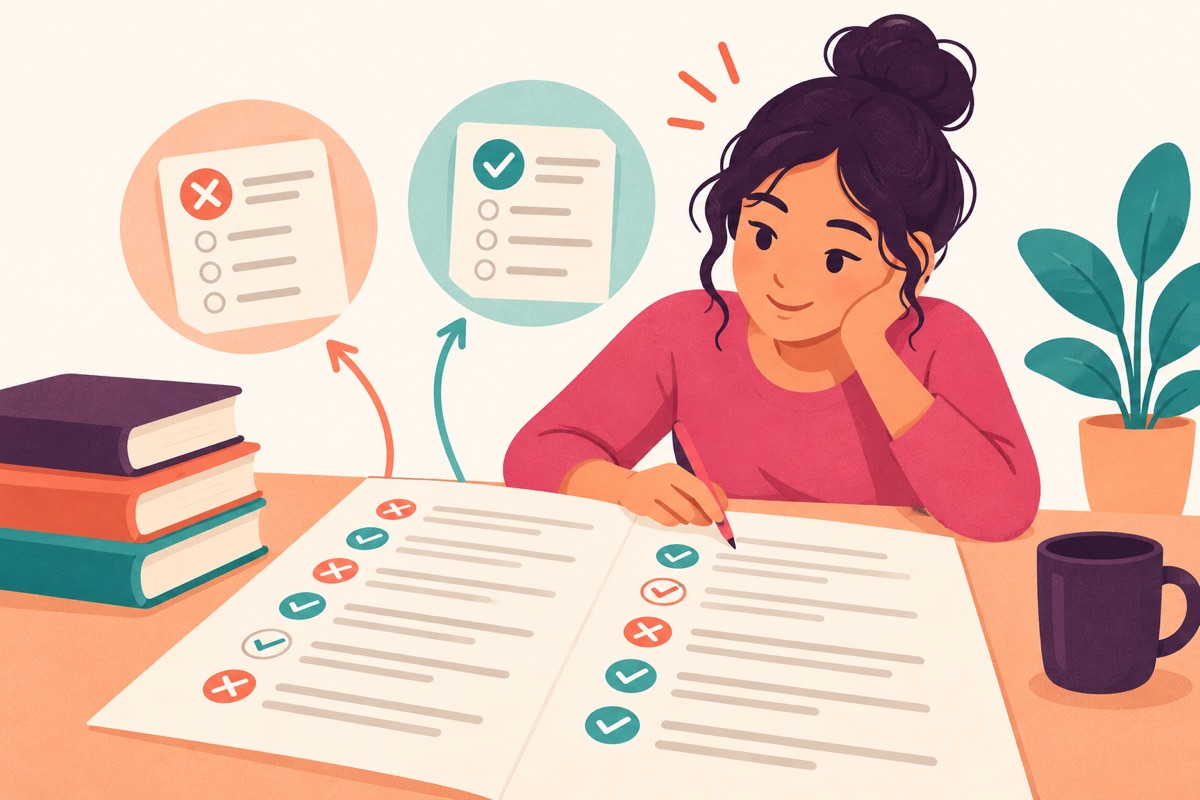
Explain Your Work Out Loud

You hit a Quant question. You scribble a little. You pick D. The practice screen says CORRECT, you get that small hit of joy, and you click Next before the feeling wears off. I watch people do this every single week. And I'll bet that a real chunk of those "correct" answers were coin flips that happened to land heads.
So here is the test I want you to run on every question you get right: explain WHY, out loud, in plain words, like you're talking to a smart 12-year-old. Not in your head. OUT LOUD. If you can't do it, you didn't solve that question. You got lucky. And luck is not a GRE method.
Why one lucky answer costs more than you think
The GRE General Test is short now. The whole thing runs 1 hour 58 minutes. Quant is two sections: 12 questions in 21 minutes, then 15 questions in 26 minutes. Verbal is two sections too: 12 questions in 18 minutes, then 15 in 23. That's 27 Quant questions and 27 Verbal questions, and there is no unscored section hiding in there. Every question counts. You can see the full layout on ETS's page about the sections and question types.
Now think about what a lucky answer does to you in practice. It LIES. It tells you that you own a skill you don't own. So you stop working on it. Then on Test Day the same idea shows up with a small twist, your luck runs out, and a point you thought you "had" walks out the door. With only 27 shots on each side, you can't afford to leak many of those.
A right answer is a result. An explanation is a method. The test rewards methods, because methods repeat. Luck doesn't.
Try one, then explain it
This is a Quantitative Comparison question. That's the GRE format where you compare two amounts, Quantity A and Quantity B, and pick one of four fixed answers. ETS describes it on the Quant section page. Do it on paper. Then, BEFORE you open the answer, say out loud why you picked what you picked.
Stop for a second. Which group were you in? Be honest. Nobody is grading this but you.
What a real explanation sounds like
A real explanation has four parts. Hit all four and you own the question.
- What was asked, in your own words.
- What you wrote down and why you wrote it.
- Why the right answer is right, step by step.
- Why the trap answer is wrong.
Part 4 is where luck gets caught. If you can't say why the tempting wrong answer fails, you don't actually know why yours works.
This goes double for Verbal. "It sounded right" is NOT an explanation. Take a Text Completion, which is a sentence or short passage with one to three blanks where you pick the word that fits. Your reason has to point at a clue in the sentence, like: "The word 'although' tells me the blank flips the idea before it, so I need a word that means the opposite of 'eager.'" If your reason is "the other words felt weird," you guessed. Maybe you guessed well. Still a guess.
The mistakes I watch people make
Only explaining the ones you missed. Wrong answers feel like the problem, so that's where review stops. But your lucky rights are hidden misses, and they never get looked at.
INSTEAD: explain EVERY question in a set, right ones first. That's a big part of how you review a practice test the right way.
Explaining it in your head. Your head is a generous grader. It skips steps, nods along, and says "yeah, yeah, I get it."
INSTEAD: say the words out loud, full sentences, every step. The moment you stall mid-sentence, you've found the gap.
Using the answer as the reason. "It's D because the relationship can't be determined." That's just reading the answer back to yourself.
INSTEAD: start every explanation with "because" and name a step you actually did on paper. "Because when I tested 0, the two sides tied."
Being too proud to do it. Talking to yourself feels silly. Some people decide they're "smart enough" to skip it. THAT is the thinking that keeps scores stuck.
INSTEAD: decide what you want MORE: to feel cool at your desk, or a higher score. Do it somewhere quiet, with your phone down and zero interruptions, so nobody's watching anyway.
Explaining once and moving on. One clean explanation today doesn't mean you'll do it under the clock next month.
INSTEAD: redo the question a few days later from a blank page. If the same explanation comes out of your mouth, it's yours. If you just finished school, you already know this trick from teaching classmates the night before a final, and it's worth using while your study habits are fresh.
Why this makes you faster, not slower
Yes, explaining takes time during practice. That's the point. Every time you explain a method out loud, you lock it in. On Test Day you won't explain anything. You'll just DO it, because you've already said it fifty times. The person who never explains has to rebuild the method from scratch under the clock, and that's where the minutes go.
Pacing trouble is almost never about the clock. It's about not knowing your method cold. Explaining is how you learn it cold.
Your challenge for today
Pull 10 questions you got RIGHT this past week. Mix Quant and Verbal. For each one, say out loud what was asked, what you wrote down, why the right answer works and why the trap fails. Any question where you stall, mumble or say "it just felt right," mark it WRONG. No mercy.
Count the marks. I'll bet the number is bigger than you want it to be. Good. That number is your real study list, and you just found it in about twenty minutes. Redo every one of them tomorrow from a blank page, and explain them again.