Review a Practice Test the RIGHT Way
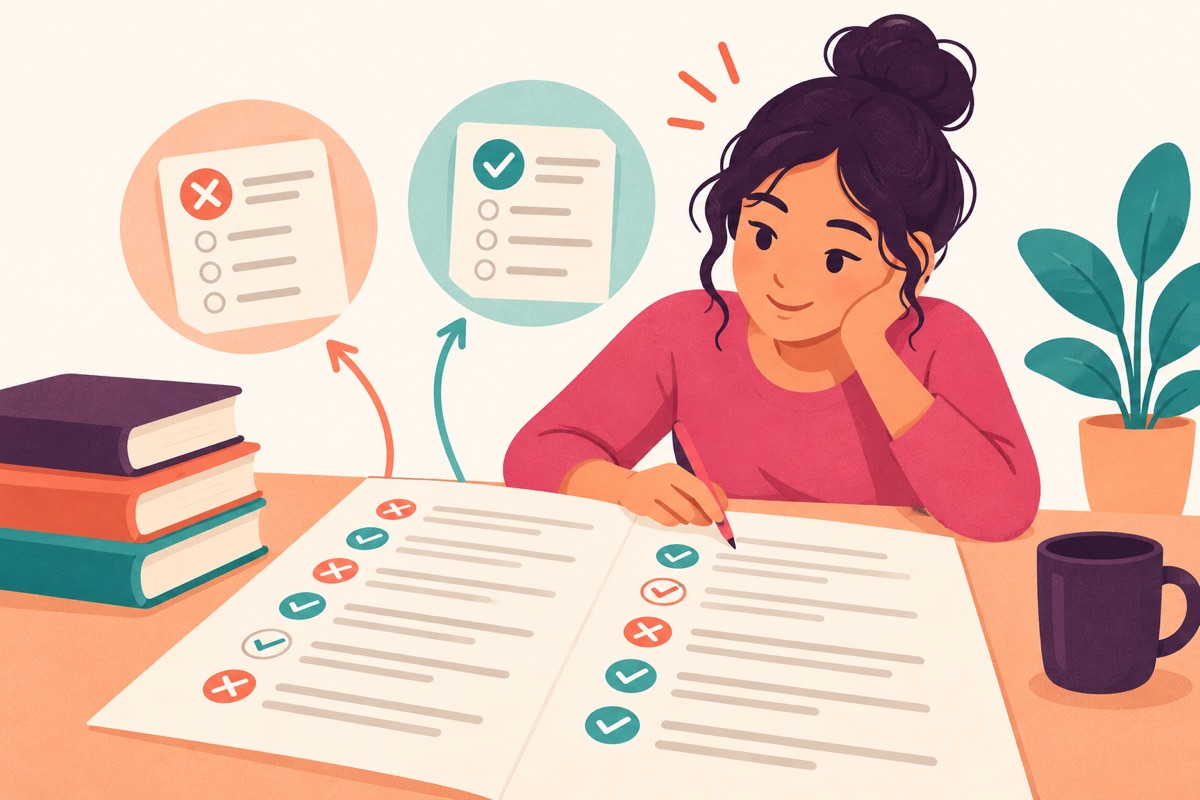
Here is a scene I watch play out every single week. You finish a full GRE practice test. You click to the results. You scroll straight to the red marks, read the explanations for the nine questions you missed, nod a few times, and close the laptop. Review done.
It isn't. You just threw away most of the test.
A practice test is a measuring device
A practice test does not make you better at the GRE. It MEASURES you. It shows how you think and work when the clock is running. The getting better happens afterward, in the review. Skip a real review and you spent two hours taking a measurement, then ignored the reading.
Do the math on the current test. The GRE General Test runs 1 hour 58 minutes. You write one Issue essay in 30 minutes. Then you get two Verbal sections (12 questions in 18 minutes, then 15 in 23) and two Quant sections (12 questions in 21 minutes, then 15 in 26). There is no unscored section, so every one of those 54 questions counts. Say you missed 9. If you only look at those 9, you studied 9 out of 54. That is one sixth of your data. The other five sixths went in the trash.
Now the wager. I'll bet that some of your right answers were guesses. I'll bet a few of them took you twice as long as they should have. Those questions are pointing straight at your next points, and you never looked at them.
Sort every question into one of four buckets
Go back through ALL 54 questions, whether you took one of ETS's free POWERPREP practice tests or another full test. For each question, ask two things. Did I get it right? Was I sure, and was I on time? Then drop it in a bucket.
| Bucket | What it means | What you do |
|---|---|---|
| Right and sure | You knew it and finished on pace | Quick check: was there a faster way? Then move on |
| Right but shaky | You guessed, narrowed it to two, or blew the time | Redo it from scratch. Treat it as a miss |
| Wrong, silly mistake | You knew how, but misread, miscopied or rushed | Find the exact moment it broke. Write it down |
| Wrong, didn't know | A rule, idea or method you don't have yet | Learn it, then do several more like it |
Stop reading for a second. Which bucket is the most dangerous? Pick one before you go on.
It's the second one. A shaky right answer looks like a win, so you leave it alone. Then on Test Day the same kind of question shows up, your luck runs out, and you have no idea why your score dropped. A lucky guess is not a skill. It's a miss that hasn't happened yet.
Watch a lucky right answer happen
Here's a Quant question in the Quantitative Comparison format. That's a GRE question type where you get two amounts, Quantity A and Quantity B, and you decide which is bigger, whether they're equal, or whether you can't tell. The four answer choices are always the same.
The mistakes that wreck a review
Reading the explanation first. You read it, it makes sense, you feel smart. But nodding along is not the same as doing it.
INSTEAD: redo the question cold, on fresh scratch paper, with no time limit. Only after you have your own answer do you read the explanation. If you still can't solve it with all the time in the world, that's a knowledge gap, not a timing problem.
Ignoring the clock. A right answer that ate four minutes cost you points somewhere else in that section.
INSTEAD: check your time on every question. On this test you get about 1.5 minutes per Verbal question and about 1.75 minutes per Quant question. Those are AVERAGES, not rules. Some questions take 30 seconds, some honestly take 3 minutes. Hunt for the ones that ran way over and ask what you were doing during that time. Rereading? Working in your head? Taking the long route?
Throwing away your scratch paper. Your paper is the record of HOW you worked. Without it, you're guessing about your own process.
INSTEAD: keep it and label it by question number. If your paper is blank next to a question you missed, you just found your problem. Most silly mistakes happen in the work you refused to write down.
Writing "careless" and moving on. 'Careless' is a label, not a cause. It tells you nothing about what to fix.
INSTEAD: name the exact break. "I read at least as at most." "I dropped a negative sign copying the equation." "I picked the answer that sounded right without checking the passage." Keep a running list. After two or three tests, the same few mistakes will show up again and again, and now you know what to train. If you just graduated, you already know how to go over a marked exam. Use that habit here.
Skipping the essay. The Issue essay is scored 0 to 6, and it's the first thing you do on Test Day. People write it, feel fine, and never read it again.
INSTEAD: reread your essay the next day. Did you take one clear position? Does every paragraph back it up with a real example? Did you leave time to fix typos? Be honest. You're grading your own work like a stranger would.
Ignoring stamina. There's no scheduled break on the current test. Two hours of focus with no pause is its own skill.
INSTEAD: compare your accuracy in your first two sections to your last two. If the mistakes pile up near the end, the issue might not be content at all. It might be that you've never trained to stay sharp for the FULL event.
Taking the next test before reviewing this one. Another test just takes another measurement. Nothing changed, so expect the same reading.
INSTEAD: finish the full review first, then spend real training time on what it showed you, then test again. If you're working through older practice tests built for the longer GRE, know how they differ from today's shorter test before you read too much into the score.
What a real review looks like
A real review of one practice test takes time. Often longer than the test itself. That's not wasted time. That's THE time. The test took two hours to find your problems. The review is where you actually fix them.
And here's the good news. The GRE is a standardized test. The question types repeat. The traps repeat. Your mistakes repeat too. Once you can name them, you can train them out, and the score you earn on the next test reflects that.
So here's your job for today. Pull up your most recent practice test. Not tomorrow. Tonight. Sort all 54 questions into the four buckets. Then redo every question in the "right but shaky" bucket, cold, on paper, no clock. Count how many you get right the second time, and be honest about it. That number will tell you more about your next score than the one on the screen did.