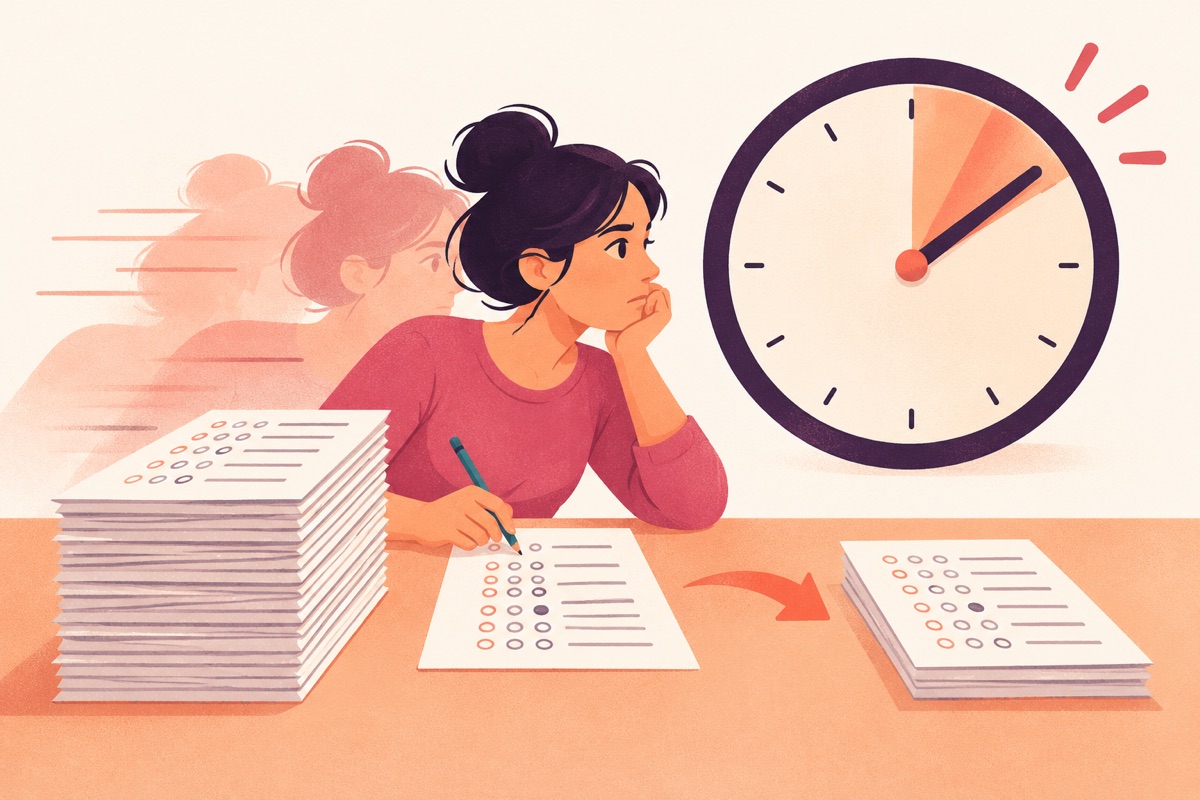
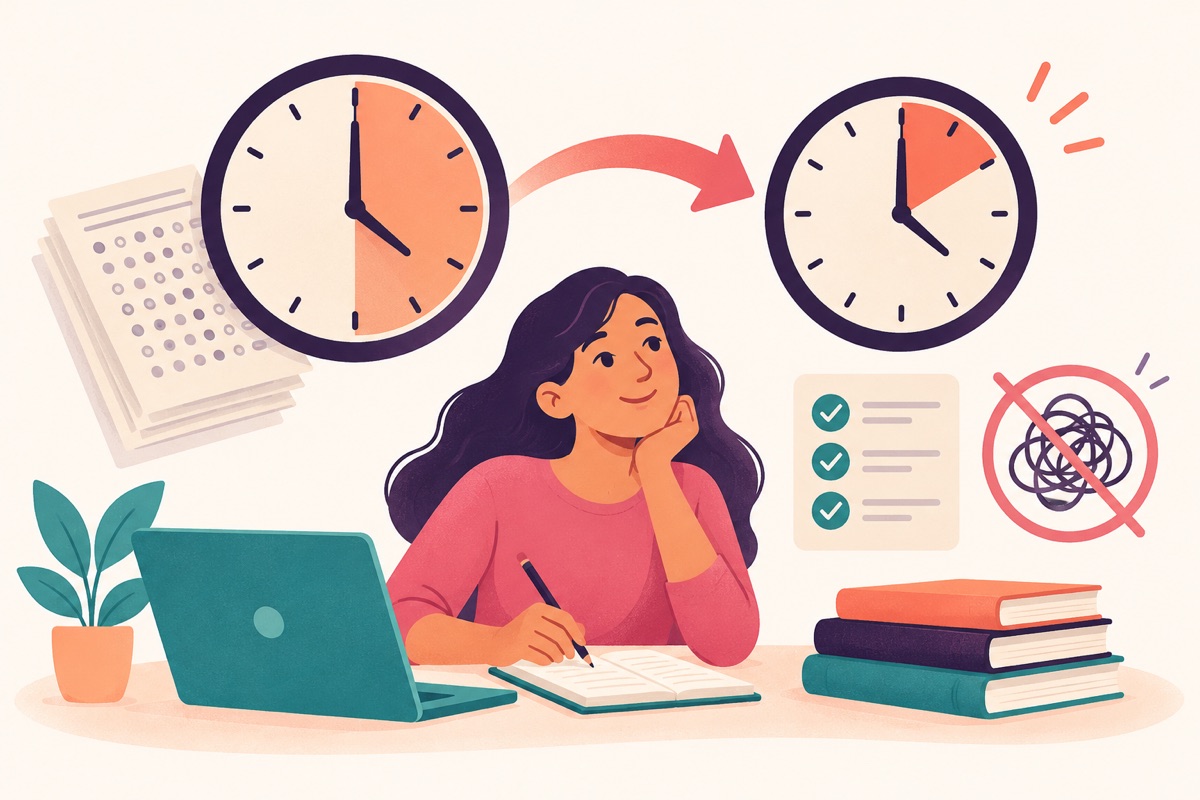
Fewer Questions, Less Room for Silly Mistakes
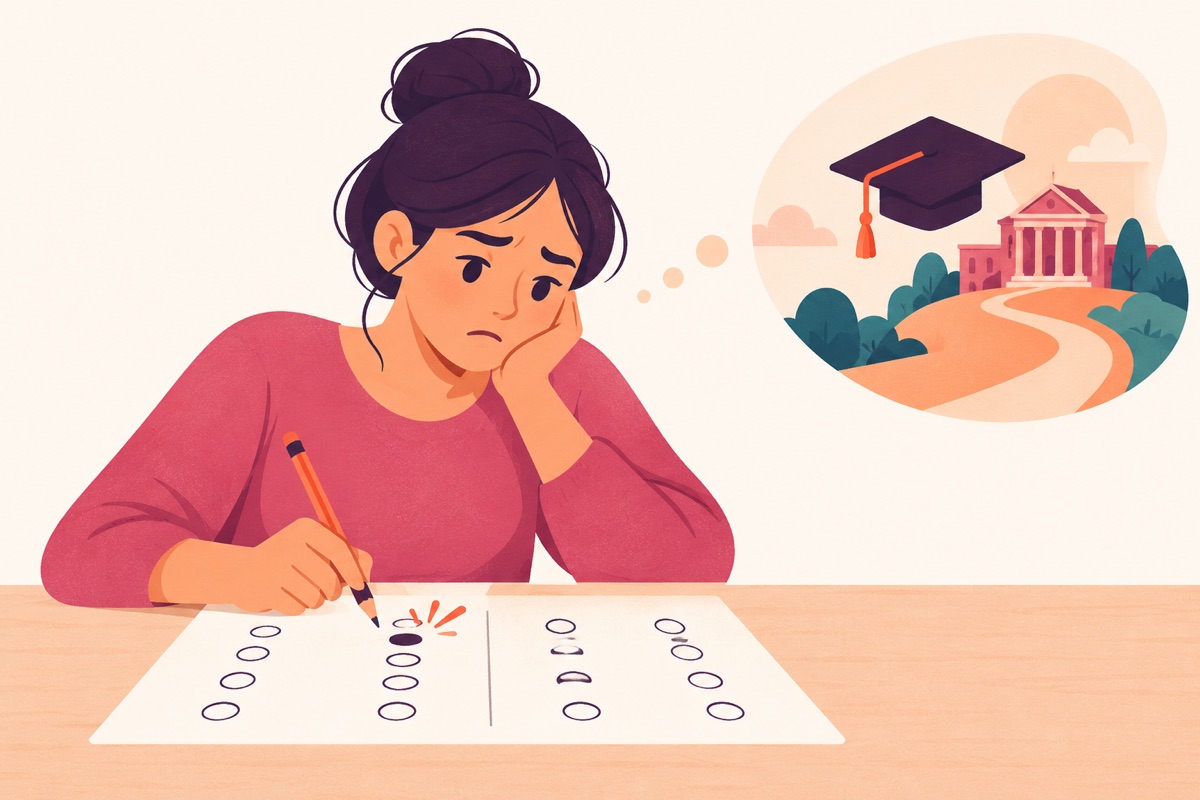
You finish a practice Quant section. You go back to review. And there it is: a question you KNEW how to do. You did the math right. You just answered a different question than the one they asked, because you never wrote down what they asked. You shrug and say 'silly mistake.' Then you do the same thing next week.
Here is my verdict: on the shorter GRE, that shrug is costing you more than ever.
Fewer questions means fewer second chances
Since September 22, 2023, the GRE General Test runs 1 hour 58 minutes. You get one Issue essay (30 minutes), two Verbal sections (12 questions in 18 minutes, then 15 in 23) and two Quant sections (12 questions in 21 minutes, then 15 in 26). If you missed the full rundown, we covered it when the GRE got shorter.
Do the math. That's 27 Verbal questions and 27 Quant questions. And there is no unscored section anymore, so EVERY one of those questions counts. On Quant, one question is about 1 in 27 of everything you'll be measured on. A longer test had more questions to soak up a slip. This one doesn't.
So stop and think about this before you read another word. If a single careless error is now a bigger slice of your score, what is the cheapest, most reliable way to stop making careless errors? Don't move on until you have an answer.
Your missing points aren't hard questions
Most people blame their score on the hardest questions. I'll bet that if you go through your last practice test and sort every miss into two piles, 'I couldn't do this' and 'I could have done this,' the second pile is LARGER. Go check. Don't take my word for it.
Those gettable misses almost always come from the same places: you misread what was asked, you dropped a condition, you did a step in your head and slipped, or you stopped one step early. None of that is a math problem. All of it is a notes problem.
Notes decide your score now
Some test takers think they're 'smart enough' to skip notes. THAT is the thinking that keeps smart people stuck. Notes aren't for people who are bad at math. They're for people who don't want to lose points they already earned.
And no, you don't 'lack the time.' Your average is 1 minute 45 seconds per Quant question in both sections, and about 90 seconds per Verbal question. The shorter test did not squeeze that, which is exactly why your pace per question didn't change. Writing a few words takes a few seconds. Re-reading the prompt because you forgot what it said takes longer, and you'll do it on question after question.
Here's what good notes look like on Quant:
- Every number, with its label (80 members, not just 80).
- Every condition, like 'x is an integer' or 'x is not 0.'
- What they actually want, circled. Underlined twice if you like.
- Every step of your work, one line at a time. Nothing in your head.
Here's the next one. This is a Quantitative Comparison question: you compare two amounts and pick one of four fixed choices. Watch what happens if you skip one small note.
5 mistakes I watch people make with notes
- Writing only numbers. A page full of 80, 25, 60 means nothing two minutes later. INSTEAD: label everything. '80 members,' '25% of March.'
- Skipping the conditions. 'x ≠ 0' and 'integer' look small. They decide answers. INSTEAD: write every condition before you do any math.
- Taking notes only on 'hard' questions. The easy ones are where you'll get careless. INSTEAD: same notes routine on EVERY question, so it becomes automatic.
- Dropping notes on Verbal. Notes aren't just for math. INSTEAD: on reading questions, jot a few words for what each paragraph does and what the question asks, so you aren't re-reading the passage over and over.
- Letting notes slide late in the test. With no scheduled break, the last section is where your routine falls apart. INSTEAD: practice full, timed runs so your notes in the last section look like your notes in the first. That's why you need to train your focus for two straight hours.
How to train it, not just know it
Knowing you should take notes is worth nothing. Doing it under the clock is the skill. That means you train it the way an athlete trains a movement: the same routine, over and over, until you don't have to think about it.
Redo questions you've already seen. Yes, even the ones you got right. You're not checking whether you remember the answer. You're checking whether your notes were clean enough that you couldn't have slipped. It's not about the right answer or the wrong answer. It's about WHAT YOU'RE DOING to get there.
And when you take a full practice test, like ETS's free POWERPREP practice tests, treat it as a measuring device. It tells you where you are. It doesn't make you better. The review afterward does, and your scratch paper is the most honest part of that review. Whether you test at a center or at home, the test format is the same, so practice the way you'll actually sit it.
Your challenge for today
Pull up the last 10 Quant or Verbal questions you got wrong. Redo every one, on paper, with full notes: labels, conditions, what's asked, every step. Then put each miss in one of two piles: 'couldn't do it' or 'could have done it.' Count the second pile. That number is the score you are leaving on the table, and you can start taking it back tonight.