No Break on the New GRE: Train Your Focus for Two STRAIGHT Hours

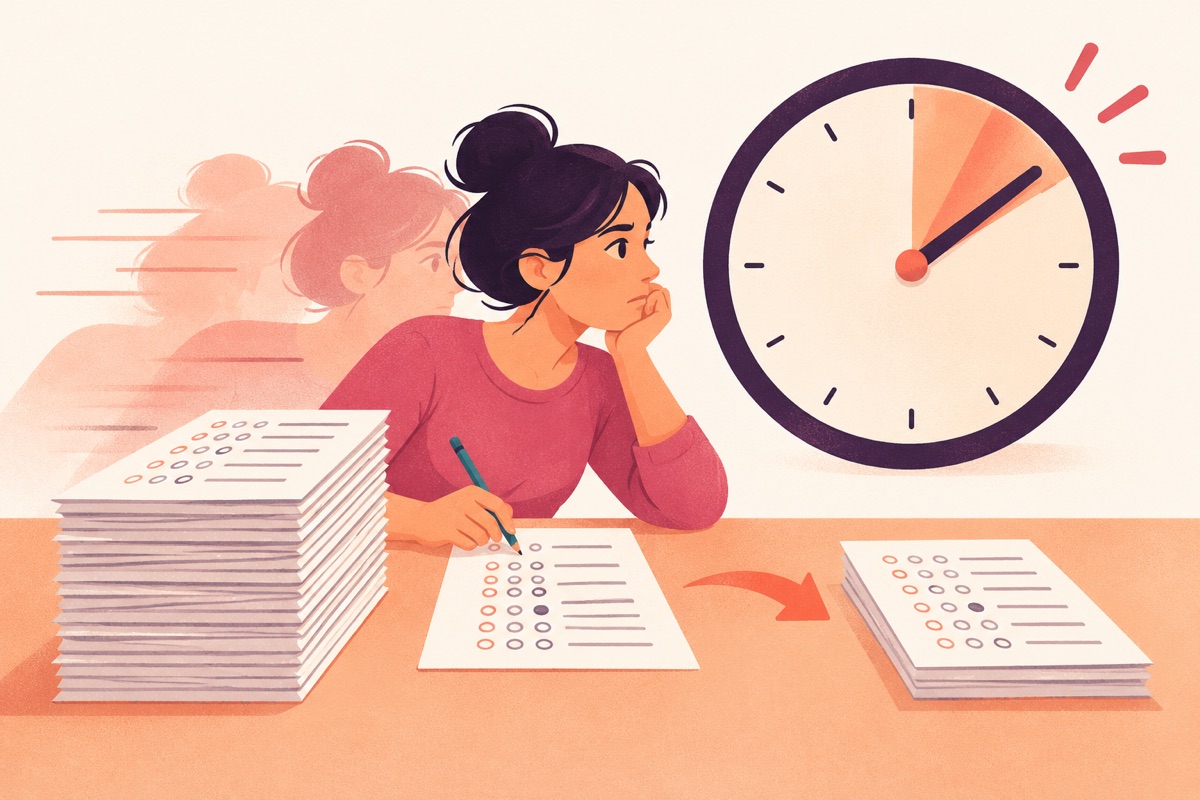
Picture minute 97. You have been staring at a screen for over an hour and a half. The question in front of you is one you would crush on a Tuesday night at your kitchen table. Today you read it three times, pick the answer that "feels right," and move on. You got it wrong. Not because it was hard. You got it wrong because your brain clocked out ten minutes ago and forgot to tell you.
I watch people make this mistake every week. They train their knowledge and never train their focus. On the new GRE, that is a TERRIBLE plan. The good news is that focus is trainable, the same way a runner trains for distance. Here is how.
The shorter test is a denser test
Since September 22, 2023, the GRE General Test runs 1 hour and 58 minutes. That is 118 minutes, and you can see the full layout on ETS's GRE General Test page. If you missed the rundown, our post on what changed on September 22 covers it. Here is what you are sitting through:
| Part | Questions | Time |
|---|---|---|
| Issue essay (you argue a position on a topic) | 1 | 30 minutes |
| Verbal, first section | 12 | 18 minutes |
| Verbal, second section | 15 | 23 minutes |
| Quant, first section | 12 | 21 minutes |
| Quant, second section | 15 | 26 minutes |
| Total | 1 essay and 54 questions | 118 minutes |
Two facts matter more than the rest. There is no unscored section, so there is no throwaway stretch where you can coast. And there is no scheduled break. Once the clock starts, it does not stop for you to stretch, snack or reset. Verbal and Quant are each scored 130 to 170, and the essay is scored 0 to 6, and every single one of those 54 questions feeds a score.
So the test got shorter. It did NOT get softer. Your pace per question didn't change much either: about 1.5 minutes per Verbal question and about 1.75 per Quant question. What changed is that you now hold that pace for two straight hours with no pause.
Stop and think: how long do YOU practice?
Don't read another word until you answer this. In your last week of study, what was your longest stretch of focused, timed work with no phone and no pause?
I'll bet it was LESS than an hour. Most people study in 20 or 30 minute bursts, check their phone, grab a drink and come back. That is fine for learning a concept. It is useless for training stamina. You cannot train for a two hour run by jogging around the block and sitting on a bench between laps.
5 stamina mistakes and what to do INSTEAD
Studying only in short bursts. Twenty minutes of questions, then a break. Your brain learns that focus ends at minute 20.
INSTEAD: Build your blocks up on purpose. More on that ladder below.
Pausing practice tests. The doorbell rings, so you hit pause. You get hungry, so you hit pause. Now your "two hour" test was really four 30 minute tests.
INSTEAD: Treat a full practice test like the real thing. Phone in another room. Water and a snack eaten BEFORE you start. No pause button, ever.
Skipping the essay in practice. People skip it because it is "just writing." But 30 minutes of writing drains the same tank you need for Verbal and Quant.
INSTEAD: Write the Issue essay every time you take a full practice test. It is part of the 118 minutes, so it is part of the training.
Working in your head when you get tired. Late in a session, writing feels like effort, so you stop. That is exactly when silly mistakes show up.
INSTEAD: Notes on paper for EVERY question, from the first minute to the last. Notes are not a sign you are slow. They are how a tired brain stays accurate.
Letting one bad question wreck the next three. You get stuck, you get mad, and you carry that into the next question.
INSTEAD: Practice a 5 second reset. One slow breath, a fresh spot on your paper, and a new question. Do it in practice until it is automatic.
The stamina ladder
Say you study four nights a week. Here is how to stretch your focus without burning out.
- Rung 1, about 40 to 50 minutes. One timed Verbal section and one timed Quant section back to back. A 15 question Verbal set (23 minutes) plus a 15 question Quant set (26 minutes) is 49 minutes. No pause between them.
- Rung 2, about 80 minutes. An Issue essay plus those two longer sections: 30 + 23 + 26 is 79 minutes straight.
- Rung 3, the full 118. A full practice test, all five parts, no pause. Once a week at most. A practice test is a measuring device. It tells you where you are. The training happens in the review afterward.
When you review, don't just mark right and wrong. Mark WHEN each mistake happened. If your silly mistakes bunch up in the last 30 minutes, that is not a math problem or a vocab problem. That is a focus problem, and now you know exactly what to fix.
One more thing. You can take the GRE at a test center or at home. If you are testing at home, practice at that same desk, in that same chair, at the same time of day as your appointment. If you are going to a center, practice somewhere that is NOT your comfy couch.
Stamina is a skill, not a personality trait
People say "I just lose focus on long tests" like it is their eye color. It isn't. Focus is a muscle you either train or ignore. The GRE is a predictable, standardized test, and you know the exact shape of it: 118 minutes, five parts, no break. You can see every piece on ETS's sections and question types page. Nothing about the length should surprise you on test day. The only question is whether you trained for it.
Here is your challenge for TODAY. Set a timer for 49 minutes. Do one 15 question Verbal set and one 15 question Quant set back to back. Phone in another room, notes on every question, no pause. When you finish, circle each wrong answer and write down the minute it happened. Then look at where the circles land. That page will tell you more about your score than any pep talk ever could.