Answering the Question They DIDN'T Ask
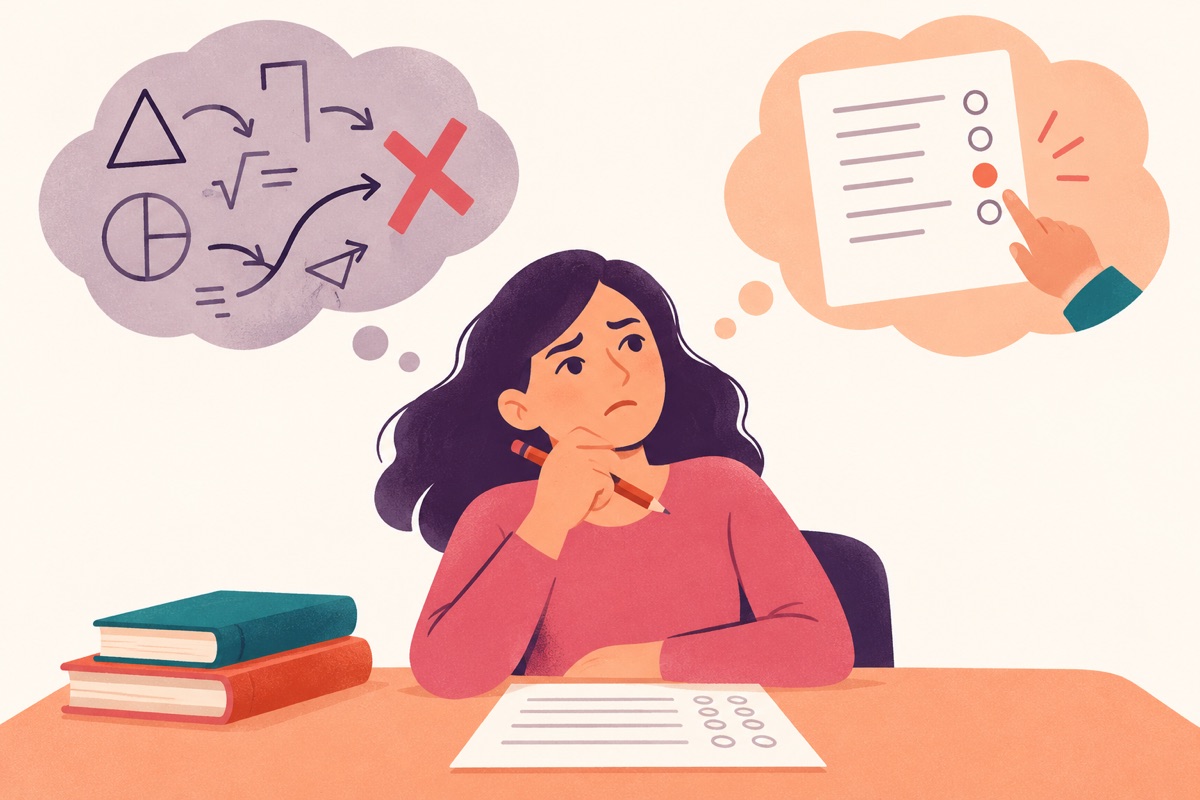
Say you just finished a practice Quant section. You open the review, find a question you missed, and rework it. Your setup is clean. Your arithmetic is perfect. You get 6, exactly like you did the first time. And the correct answer is 2.
You didn't make a math mistake. You made a READING mistake. You answered a question the GRE never asked.
I watch people do this every single week, and the worst part is how they react. They shrug, call it a 'silly' mistake, and move on. That word 'silly' is hiding something. A mistake you make once is silly. A mistake you make on every practice test is a HABIT. Habits can be trained out, but only if you stop calling them accidents.
Why the GRE loves this trap
The GRE gives you two scored Quant sections, 20 questions in 35 minutes each. The questions come in a few formats: regular multiple choice, Quantitative Comparison (you compare two amounts and decide which is bigger), and Numeric Entry (no choices at all; you type your answer into a box). You can read the official breakdown on ETS's Quant section page.
Here's what the question writers know about you: when you see a variable, you solve for it. It's reflex. So they ask for something one step PAST it. Not x, but x + 3. Not the number of pens, but how many more pens than notebooks. Not the discount, but the final price.
And the wrong answer choices? Many of them are the numbers you'll hit along the way. So when you get a number and see it sitting right there in the list, it FEELS like proof. It isn't proof. It's bait.
I'll bet that if you pull up the Quant questions you missed on your last practice test, more than one of them was right math, wrong target. Go check. Then come back.
The three-second habit
Here it is. It's almost embarrassingly simple.
- Before you do any math, find the actual question (it's usually the last sentence) and write it at the top of your scratch paper in a few words. Circle it.
- Before you click an answer, look back at the circle and ask: is my number THAT thing?
That's it. A couple of seconds at the start, a glance at the end.
Now stop for a second and think about why I'm telling you to WRITE it, instead of just telling you to read carefully. Come up with a reason before you read on.
Here's mine. 'Read carefully' is a feeling. Everyone believes they read carefully. Ink on paper is evidence. Three steps into a problem, your brain is full of numbers, and the question you read 40 seconds ago is gone. The circle isn't. It sits there waiting to catch you.
4 ways people answer the wrong question
Solving for x on autopilot. You see an equation and your hands start moving before your eyes reach the last line.
INSTEAD: Read to the question mark FIRST. Name the target on paper before you set up a single equation. Sometimes you'll find you don't even need x. You need x + 3, and there's a shortcut straight to it.
Reading the question once, at the start. You understood it when you read it. Then you did four steps of work and it quietly left your head.
INSTEAD: Circle it, and make the last-glance check part of clicking. No glance, no click.
Trusting the calculator's last number. The GRE gives you an on-screen calculator, and that's useful. But the calculator gives you a NUMBER. It doesn't give you an answer. The last thing you typed might be the cost, when they asked for the change in cost.
INSTEAD: Before a number leaves the calculator, say out loud in your head what that number IS. 'This is the number of pens.' Then compare it to the circle.
Treating a match in the choices as proof. Your number is in the list, so it must be right. That's exactly the thinking the trap is built for.
INSTEAD: A match means nothing until you've checked the circle. Also watch the units in your note: minutes or hours, percent or decimal, 'how many' or 'how many MORE'. Write the unit inside the circle.
'But I don't have time for that'
Yes you do. Do the math: a few seconds on each of 20 questions is about a minute of a 35-minute section. Now compare that to what one wrong-target mistake costs you: all the time you spent on the question, plus the point.
And here's the part that should really bother you. The GRE lets you mark questions and come back to them inside a section. That's a great tool for questions that FEEL hard. But a wrong-question mistake never feels hard. It feels finished. You'll never mark it, never come back, and never know until your review. The only defense is the one that happens before you click.
This isn't just a Quant thing either. The two Verbal sections (20 questions in 30 minutes each) are full of Reading Comprehension questions that ask what the author would most likely AGREE with, or what the passage SUGGESTS, or the primary PURPOSE of a paragraph. Answer choices that are true but answer a different question show up constantly. The same habit works: name the task, then check your choice against it.
Train it until it's boring
A habit you only use when you remember to use it isn't a habit. It has to show up on every single question, easy ones included, until doing it feels as automatic as reading the prompt. That means doing it on every practice set, and on every full-length practice test, including ETS's free POWERPREP practice tests. If you only start circling on Test Day, you'll forget halfway through the second section. This is exactly why you should rehearse Test Day before Test Day: the habits you want under pressure have to be the habits you already have.
So here's your challenge for today. Pull up your last 10 missed Quant questions. For each one, write down which kind of miss it was: didn't know the math, ran out of time, made an arithmetic slip, or answered the wrong question. Be honest. Then do 10 brand new Quant questions, and circle the target on EVERY one, even the ones that look too easy to bother. Count how many times the circle caught you. I'll bet it's more than zero.