Inequalities: The Negative Number TRAP
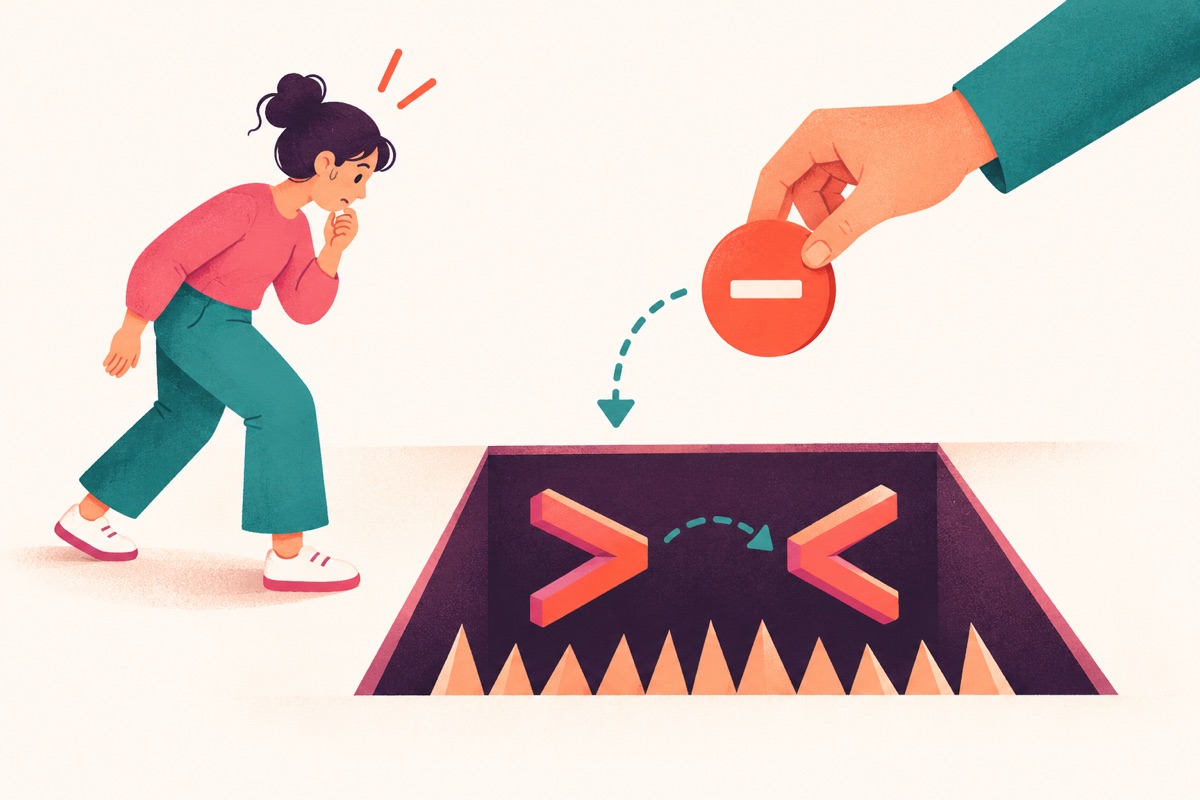
Say you're 14 questions into a 35-minute Quant section. An inequality pops up. You know exactly how to solve it. You're done in 40 seconds, you click your answer, and you feel great.
You got it wrong.
Later you read the explanation and see the words "remember to flip the sign," and you want to throw your laptop across the room. You KNOW that rule. You've known it since middle school. So what happened?
I'll bet you didn't forget the rule. I'll bet the negative was hiding, and you never slowed down long enough to look for it. That's the real trap. The good news is that it's a habit problem, not a brains problem, and habits can be trained.
The rule, and why it's actually true
An inequality is a math statement that says one thing is bigger or smaller than another, using signs like < (less than) or > (greater than). The rule: when you multiply or divide both sides of an inequality by a negative number, you flip the direction of the sign.
Don't just memorize that. Know WHY. Start with something true: 2 < 5. Now multiply both sides by −1. You get −2 and −5. Which is bigger? −2 is bigger, because it's closer to zero. So the true statement is now −2 > −5. The sign flipped.
Multiplying by a negative mirrors every number across zero. The number that was further right ends up further left. The order reverses, so the sign has to reverse with it.
Stop reading for a second and answer two questions on paper. Does adding −10 to both sides flip the sign? Does dividing both sides by −1/2 flip it? Write your answers down before you go on.
Adding or subtracting anything, negative or not, NEVER flips the sign. It just slides both sides the same distance. Only multiplying or dividing by a negative flips it. So the first answer is no, and the second is yes.
Why you still miss it
The GRE is not testing whether you know the rule. Everybody knows the rule. It's testing whether you NOTICE when the rule applies, while a clock is running and you're tired. Here are the mistakes I see over and over.
- Doing the steps in your head. When three steps get crammed into one mental flash, the flip is the first thing to fall out. INSTEAD: Write every step on your scratch paper, one line per step. Yes, even the "easy" ones. Thinking you're too smart to write it down is pride, and pride is expensive.
- The negative is buried in the middle. Take 7 − 3x > 19. You subtract 7, get −3x > 12, and that little minus glued to the 3 just disappears from your brain. INSTEAD: Before you divide, circle the coefficient (the number in front of the variable) WITH its sign. If the circle has a minus in it, flip.
- The negative is hiding inside a letter. If you divide both sides by x or by a, you have no idea whether that letter is positive or negative. You just assumed. A variable can hide a negative the same way an average can hide wildly different numbers, which is the whole point of mean, median and spread. INSTEAD: Never divide both sides by a variable unless you KNOW its sign. If you don't know it, stop doing algebra and test values: one positive, one negative.
- Flipping half of a compound inequality. A compound inequality has two signs at once, like −5 < 1 − 2x < 9. Subtract 1 everywhere to get −6 < −2x < 8. Divide by −2 and BOTH signs flip: 3 > x > −4. People flip one and forget the other. INSTEAD: Flip both, then rewrite it with the smallest number on the left: −4 < x < 3.
- Never checking. You solved it, so you trust it. INSTEAD: Pick one number from your answer and plug it into the ORIGINAL inequality. It takes about 10 seconds, and it catches a missed flip every single time.
The habit: the SIGN CHECK
Here's the habit. Every time you're about to multiply or divide both sides of an inequality, you ask one question out loud in your head: "What am I dividing by, and what's its sign?"
- If it's a positive number, keep the sign and move on.
- If it's a negative number, write the flipped sign on your paper FIRST, before you do any arithmetic. Flip, then divide. Not the other way around.
- If it's a variable and you don't know its sign, don't divide at all. Test values.
Then do the 10-second plug-in check at the end. That's it. Ask, flip, check. It feels slow for about a week. After that it's automatic, and it costs you almost nothing on Test Day.
Let's train it.
Now the nastier version, where the negative hides inside a letter. This one is a Quantitative Comparison, a GRE question type where you compare two quantities and pick one of four fixed answers. You can read how the format works on the official Quant section page.
Notice what saved you on that second one. Not a formula. A habit of asking "what's the sign?" and then trying both cases. It's the same instinct I push in probability: list the cases on paper instead of trusting your gut.
Why this matters more than it looks
The GRE gives you two scored Quant sections of 20 questions each, with 35 minutes per section, as laid out on ETS's GRE General Test page. You get an on-screen calculator, but no calculator in the world flips a sign for you. That's on you.
And here's what really stings. Inequality questions are usually GETTABLE questions. You're not losing these points because the math is hard. You're losing them on autopilot. A few of those turned back into correct answers can move your score more than cracking the one monster question you were going to guess on anyway.
Your challenge for today
Grab 10 inequality questions you've already done, including the ones you got RIGHT. Redo every one on paper with the full SIGN CHECK: write each step on its own line, circle every coefficient with its sign, flip before you divide, and plug one value back into the original at the end. Any time a letter would have to be divided, stop and test a positive and a negative.
Count how many times you would have flipped wrong, or assumed a sign, without the check. I'll bet the number is bigger than zero. Now you know exactly what you're training.