Do the SAME Question Twice. Then Do It Again.
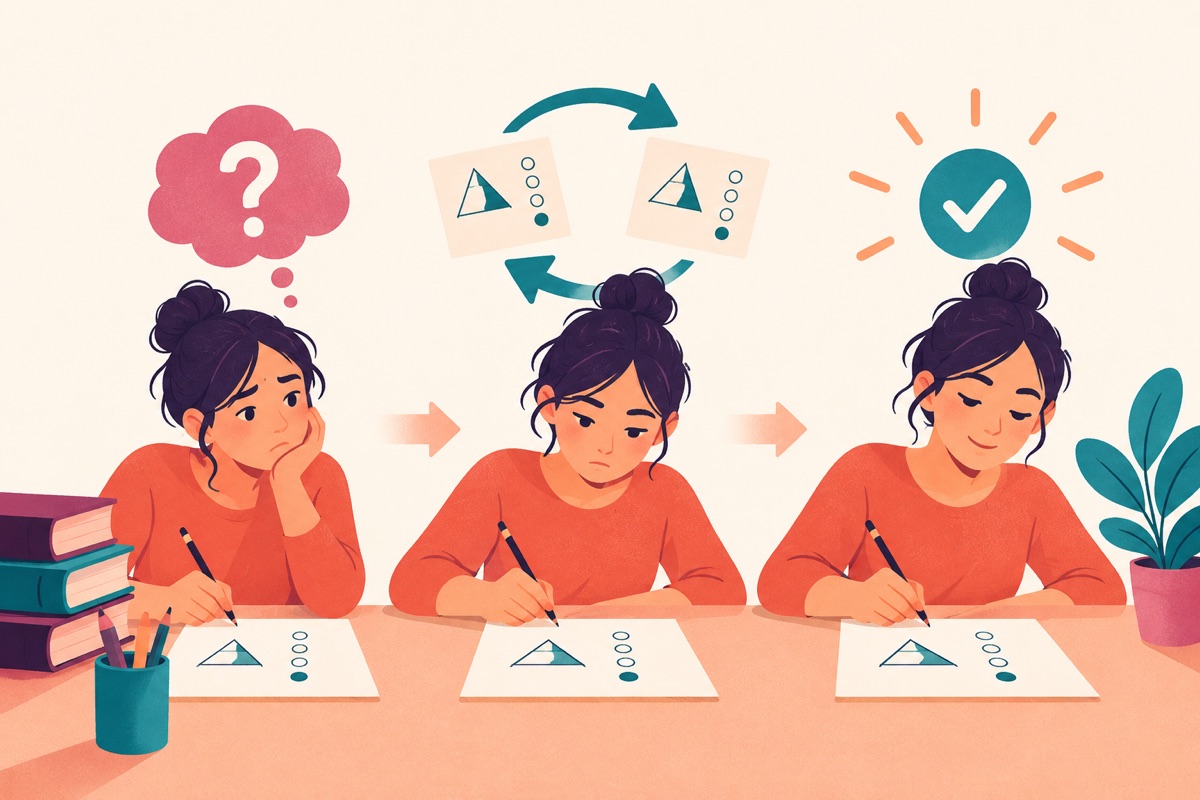
Here is a Sunday I watch play out all the time. You open your GRE book, knock out 40 Quant questions, check the answer key, count 31 right, feel pretty good, and close the book. Next Sunday you do 40 NEW questions. Ten weeks later you have "done" 400 questions, and your practice test score sits right where it started.
That is not bad luck. That is the plan working exactly as designed. The plan was built to help you SEE questions. It was never built to make you better at them.
I'll bet that if I pulled question 12 from three weeks ago and put it in front of you right now, with no answer key, you would hesitate. You might even get it wrong the same way you got it wrong the first time. Stop reading for a second and be honest with yourself about that.
Acquaintance or commander?
Here is the choice. What is MORE powerful: being an acquaintance of 400 questions, or being the commander of 100? An acquaintance has met a question once and maybe remembers its face. A commander knows its pattern, its trap and its fastest route, and can beat it cold a week later without breaking a sweat.
The GRE is a standardized test. That means ETS writes the same kinds of questions again and again. Quant covers arithmetic, algebra, geometry and data analysis, in a small set of fixed formats that you can read about on the official Quant page. The numbers change. The patterns do NOT. So your job is not to see every question that could ever exist. Your job is to OWN the patterns, and you own a pattern by doing the same question until your method is clean.
Think about a tennis player who spends an hour on one forehand. Not 40 different shots once each. The same shot, over and over, until her body does it without asking her brain for permission. That is training. Flipping through 400 questions is just visiting.
What a real redo looks like
A redo does NOT mean glancing at a question, remembering that the answer was B, and moving on. That is a memory test. You will pass it and learn nothing.
A real redo goes like this. Cover the answer and your old notes. Wait at least a few days so your memory fades. Work the question from scratch on paper, exactly as you would on Test Day, with a timer running. Then compare your work to the cleanest way to solve it. Not your ANSWER. Your METHOD.
Here is a question worth redoing. It is a Quantitative Comparison, a GRE question type where you compare two amounts and decide which one is bigger, or whether you can even tell.
See what happened there? You could get that question RIGHT and still not be done with it. If your method was "try one pair and hope," it will burn you on the next one where a second pair flips the answer.
How to tell when a question is DONE
A question is done when, days later and working cold, you can check every one of these boxes:
- You get it right on paper, with notes you could hand to a friend and they would follow.
- You get it right in a sensible time. Each Quant section gives you 35 minutes for 20 questions, so your AVERAGE is 1 minute and 45 seconds. That is an average, not a rule. Some questions take 30 seconds and some fairly take 3 minutes. But if you have seen a question three times and it still eats 4 minutes, it is not done.
- You can name the trap in one sentence.
- You can say why each wrong answer is wrong. This matters even more on Verbal, where each section gives you 30 minutes for 20 questions.
- You only touched the on-screen calculator when it actually saved time. Reaching for it to do 7 times 8 is a habit, not a strategy.
Miss ANY box and the question goes back in the pile. No exceptions.
The mistakes I see every week
- Checking the answer and moving on. You see a check mark and assume you are fine. INSTEAD: look at HOW you got there. Was it clean? Was it fast? Would it work on a question that looks a little different?
- Redoing it the next day. Your memory does the work, not your method. INSTEAD: wait at least a few days, then do it cold with your old notes covered.
- Counting questions "done" as progress. 400 questions seen means nothing. INSTEAD: count questions that pass every box on the checklist above. That number is your real progress.
- Redoing only the ones you got wrong. The question you got right after 4 minutes of panic is just as dangerous. INSTEAD: your redo pile gets every wrong answer, every guess and every slow right answer.
- Redoing in your head. "I know how to do this one" is pride talking. INSTEAD: full notes on paper, every single time, so that the habit is automatic on Test Day.
Building your redo pile
Here is something you will notice fast. Your pile will NOT be full of brutal, top difficulty questions. It will be full of medium questions that you should be getting, but keep fumbling with a silly slip or a slow route. That is not a coincidence. Hard questions are NOT costing you points. Easy ones are. Your redo pile is where you go get those points back.
The same disease shows up in Verbal prep, too. Flipping through a thousand flashcards once is the vocab version of doing 400 questions once. If that sounds like you, read why you should stop memorizing giant word lists.
And where do full practice tests fit? They are measuring devices, not training. ETS's free POWERPREP practice tests are great for finding out where you stand and feeding new questions into your pile. But taking one doesn't make you a better test taker. Redoing what it exposed does. One full practice test a week is plenty. The rest of your week belongs to the pile.
Your move today
Go find 10 questions you did at least a week ago. Cover the answers. Cover your old notes. Set a timer and do all 10 on paper, from scratch, like it's Test Day. Then run each one through the checklist. I'll bet fewer of them are "done" than you thought. Whatever fails, that's your pile. Start owning it tonight.