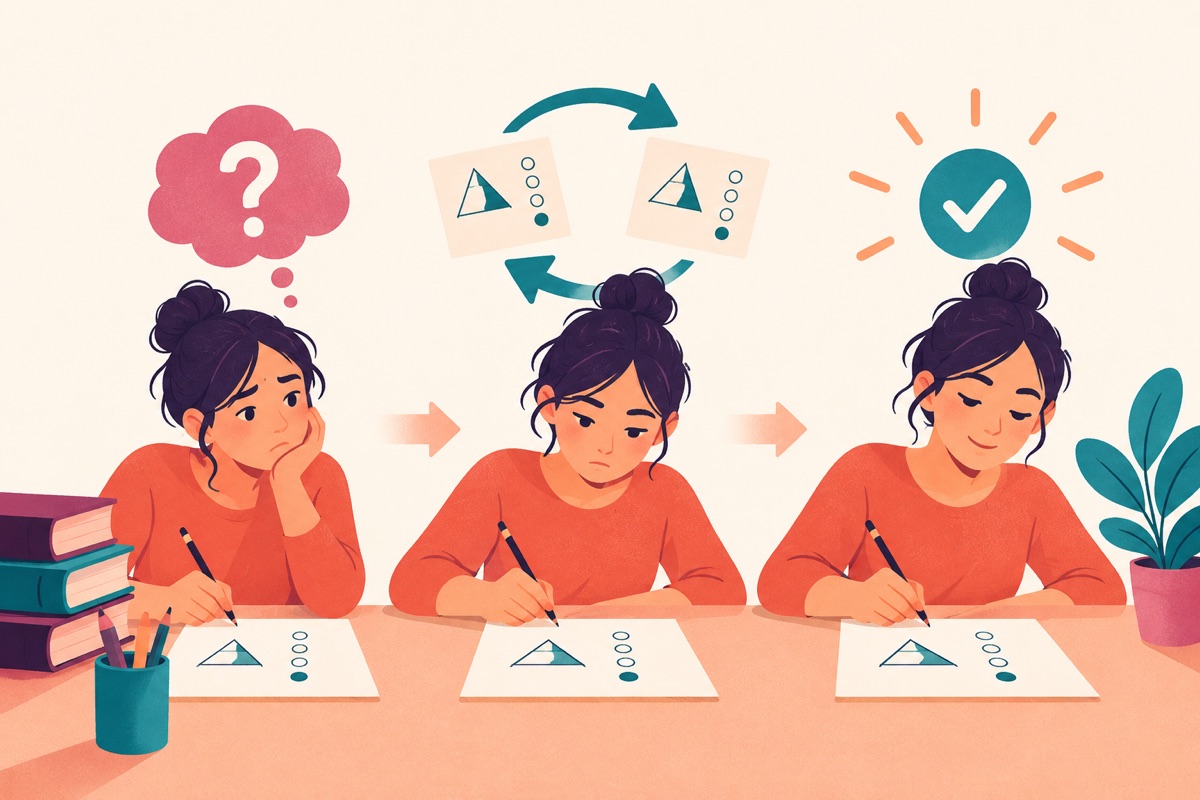
Stop Memorizing GIANT Word Lists

I watch it happen every week. Someone gets serious about the GRE, grabs a 3,000 word flashcard deck and starts flipping. On the train. At lunch. In bed. Card 412: obstreperous. Card 413: pusillanimous. It FEELS like work. There's a stack, the stack gets smaller, and a smaller stack looks a lot like progress.
Here's my blunt verdict: that deck is mostly wasted hours. Not all of it. Mostly. And every hour you burn on it is an hour you are NOT spending on the things that actually raise your Verbal score.
If you're 900 cards in, don't get too down on yourself. The fix is simple, and you can start it tonight.
Do the math on that deck
Say you spend 30 seconds on each card. One pass through 3,000 cards is 90,000 seconds. That's 1,500 minutes. That's 25 HOURS. For ONE pass. And nobody remembers a word after one look, so you'll go through that deck again and again.
Now stop. Before you read another word, answer this: of those 3,000 words, how many will actually show up on YOUR test? Write a guess down.
I'll bet your guess is small. The Verbal side of the GRE is two scored sections of 20 questions each, 30 minutes per section. That's 40 scored Verbal questions. Some of them are reading questions where a fancy word never comes up. Even on the questions that lean on vocabulary, each one tests only a handful of words, and the sentence itself usually tells you most of what you need. A 3,000 word deck is a lottery ticket. You're memorizing thousands of words hoping to hit a few.
What the vocab questions REALLY test
Two question types lean on vocabulary. Text Completion gives you a short passage with one to three blanks, and you pick the word that fits each blank. Sentence Equivalence gives you one sentence with one blank and six choices, and you have to pick the TWO choices that both fit and make the sentence mean the same thing. ETS describes both on its Verbal Reasoning page.
Here's what most people miss. These are NOT definition quizzes. They are reading questions. The sentence always holds a clue that tells you what kind of word belongs in the blank. Find the clue and you can often get full credit while knowing only SOME of the words. Watch.
5 vocab mistakes I see all the time (and what to do INSTEAD)
Memorizing a definition with no sentence around it. A word with no context is just a sound. You'll "know" it on the card and freeze when it shows up inside a twisty sentence.
INSTEAD: learn every word inside a sentence. Then write your OWN sentence that uses it. If you can't use it, you don't know it yet.
Starting with the giant deck. Somebody else picked those 3,000 words. They have no idea which words YOU already know and which ones you don't.
INSTEAD: build your list from the questions you actually work. Every time you hit a word you can't define in a practice question (in the sentence OR the answer choices), write it down with the sentence it came from. That list is made of words test writers really chose, and it's built around YOUR gaps.
Never reading anything harder than a text message. GRE writing has a style: dense, careful, a little formal. If you never read that style, every passage feels like a foreign language.
INSTEAD: read 20 minutes a day of serious writing. Long magazine pieces on science, history or economics. The opinion pages of a major newspaper. Pencil in hand. Every word you can't pin down goes on your list, with its sentence. You pick up words AND train your reading at the same time.
Blaming every miss on vocabulary. You miss a Text Completion and think, "I didn't know the word." Is that REALLY why? I'll bet that a lot of the time you knew every word on the screen and still missed it, because you didn't find the clue, didn't write a prediction and let the choices steer you.
INSTEAD: on every missed question, write down the exact reason. Unknown word? It goes on your list. Missed clue? That goes in your method notes. Be honest with yourself. Those method misses are the same kind of thing I wrote about in the easy questions that are actually costing you points.
Flipping cards instead of redoing questions. Cards train you to recognize a word alone. The test never shows you a word alone.
INSTEAD: a week after you work a set of Verbal questions, redo them from scratch, notes on paper, clue, prediction, match. You'll meet the same words in the same sentences, and they'll stick far better than any card. And while you're at it, remember the test also has two scored Quant sections. Every hour on a deck is an hour your Quant isn't getting.
So should you learn ANY words?
Yes. Vocabulary matters. A strong vocabulary makes every Verbal question faster and less stressful. The point is NOT "learn no words." The point is "learn the RIGHT words the RIGHT way." Your own list, pulled from your questions and your reading, will be far shorter than 3,000 words, and every word on it will have earned its spot. Review it a few minutes a day, always in sentences.
One more trick worth training: when you only half know a word, ask yourself one question. Is it positive or negative? You don't need the exact meaning to know that pusillanimous doesn't sound like a compliment. If the blank needs a positive word, a negative one is out. Sometimes that's all the elimination you need.
So here's the forced choice. What do you want MORE: the nice feeling of a shrinking stack, or a higher Verbal score? You can't spend the same 25 hours on both.
Your move today
Put the giant deck in a drawer. Pull up the last 20 Verbal questions you worked. Go through every sentence and every answer choice and write down each word you couldn't define, with the sentence it came from. Next to each one, write a sentence of your own. Then redo every question you missed, clue first, your own word on paper, then the choices. When you're done, look at that short list in your hand and ask yourself which one actually made you better: 25 hours of flipping, or the next hour of THIS.