The Unscored Section Is a TRAP for Lazy Test Takers
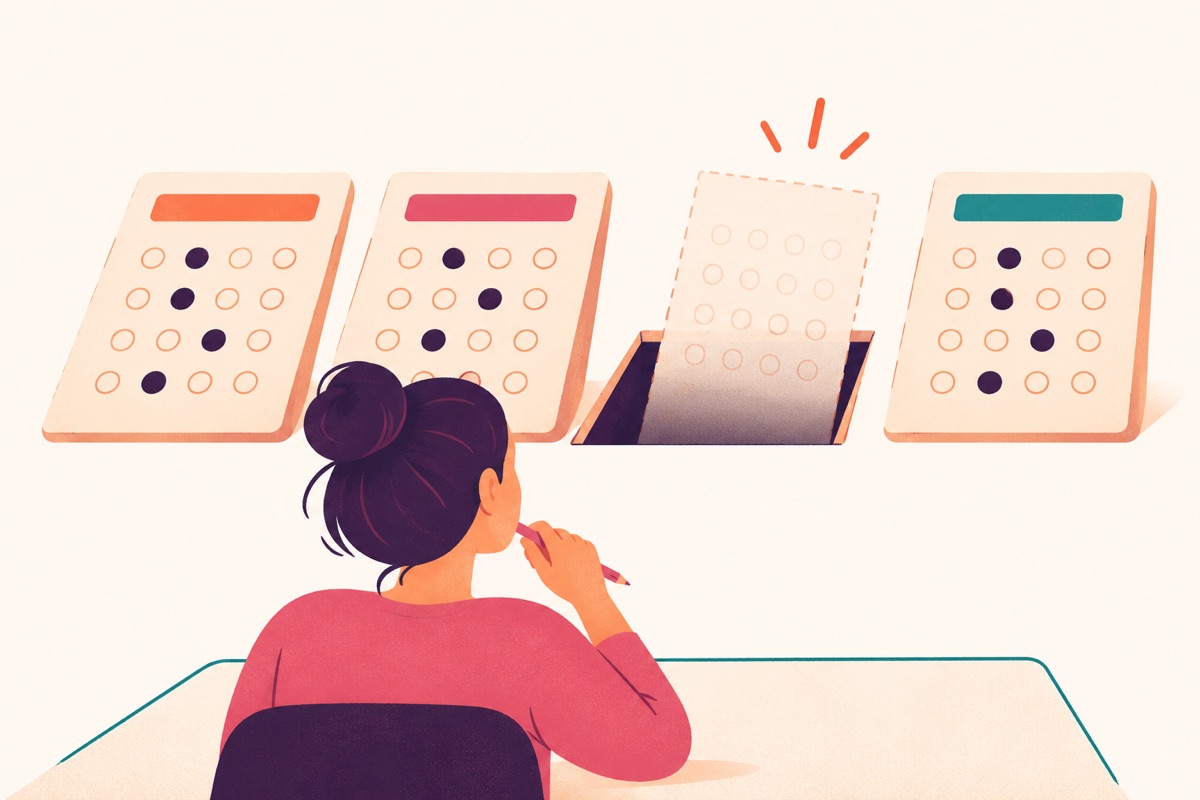
Say you're about two hours into your GRE. You click into the next section and there it is: a THIRD Quant section. You already did two. A little voice in your head says, "This is the fake one. Relax. Save your energy."
That little voice is about to cost you points. It sounds smart. It feels like strategy. It's actually just laziness wearing a nice suit.
What the unscored section actually is
The GRE General Test gives you an Issue essay and an Argument essay (30 minutes each), two scored Verbal sections (20 questions in 30 minutes each) and two scored Quant sections (20 questions in 35 minutes each). On top of that, there's one unscored section. "Unscored" means your answers there do NOT count toward your 130 to 170 Verbal and Quant scores. You can read the full layout on ETS's sections and question types page.
Here's the catch. The unscored section looks EXACTLY like the others. Same kinds of questions. Same timer. Same screen. Nobody taps you on the shoulder to tell you which one it is. So you'll see three Verbal sections or three Quant sections, and one of those three doesn't count. You won't know which one.
I'll bet you can't pick it
Let's do the math, because this is a math problem before it's anything else.
Say you see three Quant sections. Unless you have inside information (you don't), your best guess at which one is unscored is 1 out of 3. So if you pick one and coast through it, 2 out of 3 times you just coasted through a section that COUNTS.
Stop reading for a second and think about that. Would you put your grad school application on a bet you lose 2 times out of 3? Nobody would say yes out loud. But Test Takers make that exact bet every week, because in the moment it doesn't feel like a bet. It feels like a break.
And it gets worse. The GRE is adaptive section by section. That means how well you do on your first scored Quant section helps decide how hard your second scored Quant section will be. If you coast through a section that turns out to be your first REAL one, you don't just lose points there. You can get handed an easier second section, and easier questions put a lower ceiling on how high your score can go. One lazy section can drag down two.
Why "lazy" is the right word
Be honest about when this thought shows up. It almost never shows up in the first hour. It shows up late, when you're tired, after the 10 minute break that comes after the third section, when your brain is looking for permission to stop working hard. "This is the fake one" is not analysis. It's fatigue asking for a nap.
The good news: fatigue is trainable. This test runs about 3 hours and 45 minutes, and you can train to be just as sharp in hour three as you are in hour one. That's the real fix, not a guessing game.
The mistakes I watch people make
Trying to "spot" the unscored section. People look for clues: weird questions, a strange topic, a section that feels off. None of that tells you anything you can trust.
INSTEAD: Decide before Test Day that EVERY section is scored. No exceptions, no debate in the moment. You can't lose a bet you never make.
Treating a hard section as the fake one. "These questions are brutal, so this must not count." Think about what adaptive means. A tougher section can be a sign you did WELL on the one before it.
INSTEAD: When a section feels hard, slow down, take notes and work the process. Hard is not fake. Hard might be good news.
Only practicing in short bursts. If you only ever do 10 questions at a time, your brain has never had to perform in section five. Of course it wants to coast there.
INSTEAD: Take full-length, timed practice tests, like ETS's free POWERPREP tests. But don't go crazy: one practice test per week, MAXIMUM. A practice test measures you. Training between tests is what makes you better.
Telling yourself "I'll just retake it." Yes, ScoreSelect lets you send only the scores you pick. That is NOT a reason to throw away a section on purpose.
INSTEAD: Walk in planning to be done after one test. Every retake costs you time, energy and weeks you could spend on your applications.
Dropping your notes when you get tired. The first thing people stop doing late in the test is writing things down. That's exactly when the silly mistakes pour in.
INSTEAD: Notes on paper for every question, in every section. Late in the test, your notes matter MORE, not less.
Every question gets the full process
Here's the kind of question people blow when they're in "this one doesn't count" mode. It's a Quantitative Comparison, a GRE question type where you compare two amounts, Quantity A and Quantity B, and decide which is bigger, or whether you can even tell. It's not hard. It's EASY to get wrong if you go fast and lazy.
Notice what happened there. The math was simple. The points came from the PROCESS: notes, test values, try to break it, confirm. That process doesn't care whether the section is scored. It works the same in section two and section five. That's the point. If you run it on every question, you never have to wonder which section counts.
The bigger picture
This is athletic training, not a guessing game. A marathon runner doesn't pick a random mile to walk because "maybe that one won't count." They train for the FULL distance so every mile looks the same. Think about who has their MBA a few years from now: the person who tried to outsmart the test, or the person who simply out-trained it?
The GRE will give you the score you EARN. And since it's a predictable, standardized test, every bit of it can be trained for, including that tired, slumping feeling in the later sections.
Your challenge for today
Tonight, after a full day of work or class, when you're already a little tired, sit down and do one Quant set: 20 questions in 35 minutes, notes on paper for every single one. Then look at your accuracy and compare it to a set you did when you were fresh. That gap is the size of your coasting problem. Now you know exactly what to train.