Word Problems: Translate EVERY Sentence Into Notes

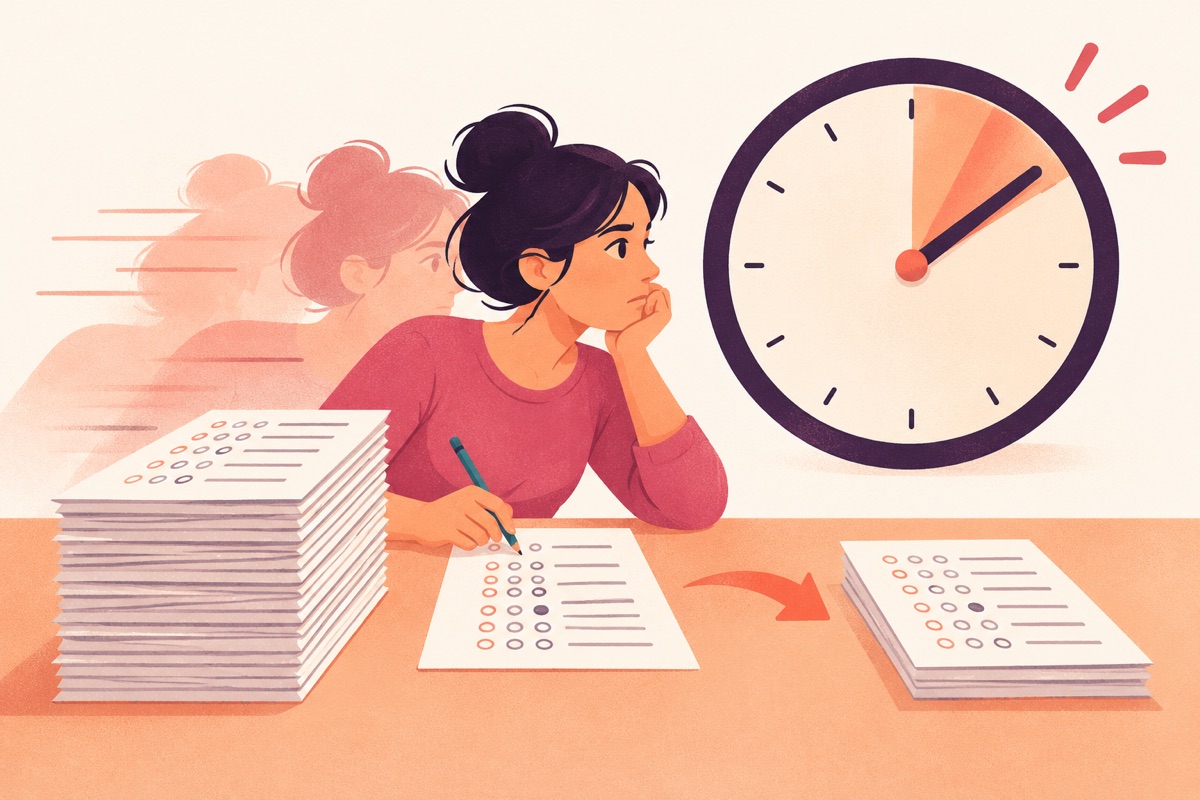
Here's a scene I watch play out every week. You start a GRE word problem. It's five sentences about a bakery, two days of sales, a "3 times as many" and a "12 more than." You reach the question at the end and realize you have NO idea what the second sentence said. So you go back and reread it. Then you read it a third time, slower, with your finger on the screen.
I'll bet that's you on at least a few questions per section. And I'll bet you've told yourself the reason is that word problems are 'hard.'
They're not. The math inside almost every GRE word problem is stuff you learned before high school: add, subtract, multiply, set two things equal. The hard part isn't the math. The hard part is that you're trying to hold an entire story in your head while ALSO doing the math. Your brain isn't built to do both at once. Nobody's is.
The real cost of rereading
A word problem is any Quant question that hands you a little story instead of an equation and asks you to dig a number out of it. On the GRE, each Quant section gives you 20 questions in 35 minutes. Do that math: 35 divided by 20 is 1 minute and 45 seconds per question, on average.
Now say you burn 15 seconds rereading on just half of the 40 questions across your two scored Quant sections. That's 20 times 15, which is 300 seconds. FIVE minutes. That's almost three full questions' worth of time, spent reading words you already read.
So when you tell me you have a 'pacing problem' on word problems, I'm going to tell you it isn't a clock problem. It's a notes problem. Fix the notes and the clock fixes itself.
One sentence, one note
Here's the rule: EVERY sentence in a word problem becomes a note on your scratch paper before you read the next sentence. Not after you finish the whole prompt. Not "when it gets complicated." Every sentence, as you go.
- Name things with letters that mean something. Muffins get M. Scones get S. Not x and y, because three minutes from now you won't remember which was which.
- Turn the words into math right away. "3 times as many muffins as scones" becomes M = 3S. Write it, then move on.
- Write down what the question asks for, and circle it. The GRE loves to ask for the one number you weren't looking at.
- Then stop reading and start working. When your notes are done, the story is gone. All that's left is a small pile of math.
Notice what that does. By the time you reach the last word of the prompt, you're already set up to answer. No rereading. No "wait, which day had the extra scones?"
This is the same idea behind weird symbol questions: the test is handing you instructions, and your job is to write them down and follow them. Stop reading this post for a second and think about the last word problem you got wrong. Was the math the issue, or did you lose a piece of the story?
Watch it work
Here's one in the standard multiple choice format, where you pick one answer from five choices.
Notice that none of that math was hard. Every step was a single line. What made it look hard was four facts tangled together in a paragraph.
The mistakes I see every week
- Reading the whole prompt first "to get the big picture." By the end, the first two facts have already leaked out of your head. INSTEAD: note as you read. The big picture builds itself on your paper.
- Writing down only the numbers. A lonely "12" on your paper means nothing. "Tue S = Mon S + 12" means everything. INSTEAD: write the relationship, not just the number.
- Flipping "fewer than" or "more than." "8 fewer muffins than Monday" is M − 8, not 8 − M. INSTEAD: check your note with a quick test value. If M were 20, 8 fewer would be 12. Does your note give 12? Good.
- Letting the calculator do the thinking. The GRE gives you an on-screen calculator, and it's great at arithmetic. It can't set up a problem. INSTEAD: setup goes on paper first. The calculator only comes out for ugly numbers.
- Thinking you're 'too good at math' for notes. THAT is pride, and pride is the most expensive habit on this test. Strong math students lose points on word problems all the time, and it's almost never the math. INSTEAD: decide what you want MORE: a higher Quant score, or the feeling of doing it all in your head.
It works on every kind of word problem
This isn't just a rate problem trick or an age problem trick. Some word problems are counting problems in disguise, and there the first note you write is whether order MATTERS. Some are geometry problems wearing a story, and there your notes are a quick sketch plus a few triangle rules. The format of the note changes. The habit doesn't.
And remember, you can skip a question, mark it and come back to it inside a section. That only helps if your notes are still sitting there when you return. Come back to a question with no notes and you're starting over from the first sentence.
Your move today
Pull five word problems you've already done. Redo each one with one note per sentence, and one hard rule: once you've read a sentence, you are NOT allowed to look back at it. If you have to look back, your note for that sentence wasn't good enough, so rewrite it until it is. Time each problem. Then compare those times to the first time you did them, and tell me which way was faster.