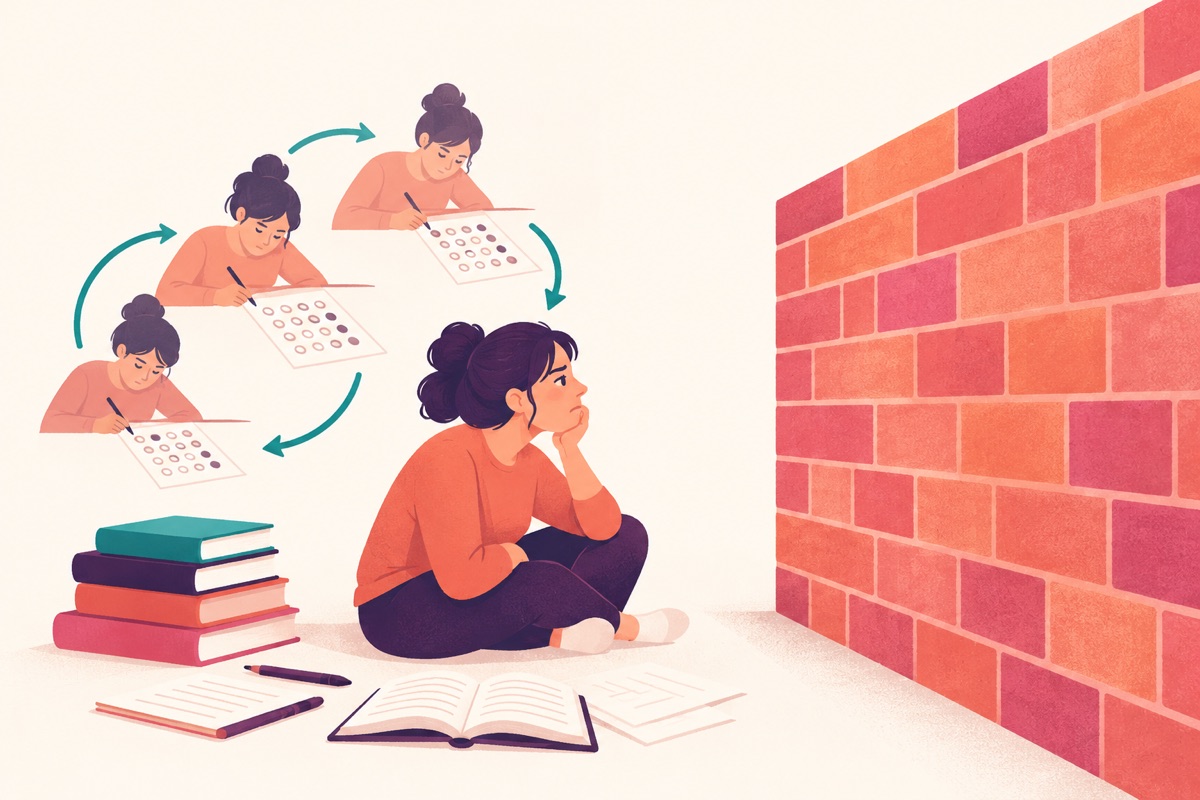
A Stack of Books Is Not a Study Plan

Picture the desk. Five GRE prep books, stacked like bricks. Two still have the plastic on. One has a neon highlighter stripe through chapter one and nothing after page 40. You look at that stack and you feel READY.
You're not. A stack of books is not a study plan. It's a receipt.
That's the hard part. Here's the good part: this is fixable today, and you probably already own everything you need. Buying materials feels like progress because it costs money and takes effort. But the GRE doesn't care what you own. It cares what you can DO with 20 Quant questions and 35 minutes on the clock.
The wager
I'll bet you haven't finished a single one of those books. I'll bet you've started three of them, because every book opens with the basics, and the basics feel comfortable. Go check. Open each book, find the last page you actually worked, and write the page numbers down.
Now stop reading and think about it. If you've covered the basics three times, what have you trained? You've become an acquaintance of a lot of pages. What you need is to be the commander of a smaller pile of questions: questions you've done, reviewed, redone and can now crush on demand.
What you're actually training for
As of today, the GRE General Test runs about 3 hours 45 minutes. You write two essays first, an Issue essay and an Argument essay, 30 minutes each. Then you face two Verbal sections (20 questions in 30 minutes each) and two Quant sections (20 questions in 35 minutes each). There's also one unscored section that looks just like the others, so you can't tell which one doesn't count. You get a 10 minute break after the third section.
The test is adaptive section by section. That means how you do on your first Quant section decides how hard your second Quant section is. You get an on-screen calculator, and you can skip, mark and change answers inside a section. ETS, the company that writes the test, lays out every question type on its test content page.
That is a long, timed event. Reading about it is like training for a marathon by reading about running. Your materials have to make you RUN.
How to pick materials that actually train you
Hold every book in your stack up to these four questions.
- Is it written for THIS test? The current version of the GRE has been around since August 2011. Older material describes a different exam. Look for the current question types: Quantitative Comparison (compare two amounts), multiple answer questions (pick every choice that works), numeric entry (type your own number), Text Completion (fill in the blanks in a short passage) and Sentence Equivalence (pick two words that give a sentence the same meaning).
- Does it teach you to think, or just to calculate? Good material shows you faster routes: testing values, working backward from the answers, estimating. If every explanation is three lines of algebra, you bought a math textbook.
- Are the explanations worth reading? You learn more from reviewing a question than from answering it. Thin explanations mean thin training.
- Does it include official questions? ETS writes the real thing, so its questions are the standard for how the test reads. Its free POWERPREP practice tests are the closest you'll get to Test Day.
Most stacks fail the second test. Here's what the difference looks like on a real question.
A book that only teaches the factoring is training you to be a mathematician. The GRE rewards strategists.
Five mistakes I watch people make every week
- Switching books the moment one gets hard. Chapter 6 is tough, so you open a different book and start at chapter 1 again. That's not studying. That's escaping. INSTEAD: pick ONE core resource and finish it, start to end.
- Reading lessons without doing questions. Nodding along to an explanation feels like learning. It isn't. INSTEAD: every lesson ends with timed questions, worked on paper, with notes on every single one.
- Doing each question exactly once. You got it right, so you move on forever. INSTEAD: a week later, redo every question you missed AND every one you guessed on. If you can't get it again, cleanly and on time, you didn't own it.
- Treating practice tests as training. A practice test is a measuring device. It tells you roughly where you are. It does NOT make you better. And when your scores move a little from test to test, practice scores bounce around for reasons that have nothing to do with your books. INSTEAD: one full-length test per week at most, essays included, in one sitting, with the break taken exactly like Test Day.
- Buying a new book when your score stalls. A plateau almost never means you're missing a book. It means something in your process is broken. INSTEAD: if you're 'stuck' at the same score, look at HOW you're studying before you look at WHAT you're studying with.
What to do with the rest of the stack
Here's the forced choice. What do you want MORE: the comfort of owning every GRE book in print, or a higher score? You can't have both, because a crowded desk splits your attention five ways.
So keep two things on the desk: the official ETS material and one core resource that passes the four questions above. Everything else goes on a shelf. Not in the trash. On a shelf.
Those extra books become a drill pool, not a curriculum. Say your notes show you keep missing rate questions, or you blow Sentence Equivalence when two answer choices look close. THEN you pull extra questions on that one topic from the shelf, do them, review them, redo them, and put the book back. You go to the shelf with a specific reason, or you don't go at all.
Your move, today
Tonight, clear the desk. Every book comes off. Put back exactly two. Then do 10 Quant questions from your core resource, timed, with notes on paper for every single one. Tomorrow, redo the ones you missed before you touch anything new.
That's a study plan. The stack was never going to be one.